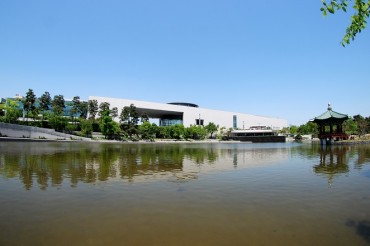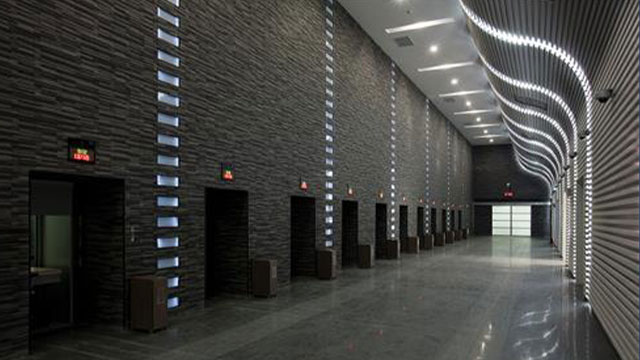
Crematoriums have traditionally been regarded as among the most undesirable facilities in local communities. The photo shows the Seoul Metropolitan Crematorium located in Goyang, Gyeonggi Province. (Yonhap)
SEOUL, Jan. 27 (Korea Bizwire) — As South Korea’s population ages, anxieties over access to cremation facilities have resurfaced among grieving families, echoing memories of last winter’s so-called “cremation crisis,” when a surge in deaths led to delays in funeral schedules.
Yet government data and industry officials say that, for now, the system remains largely stable — even as longer-term pressures continue to build.
According to the Korea Funeral Culture Promotion Institute, 75.5 percent of cremations nationwide last year took place within three days of death, a modest decline from the previous year but still within what authorities consider a manageable range. The figure has remained in the 70 percent range for four consecutive years, down from above 80 percent earlier in the decade.
The drop has fueled public concern, particularly in densely populated areas. In Seoul, the three-day cremation rate stood at 69.6 percent last year, while Gyeonggi Province fell to 63.1 percent and Busan to 67.1 percent.
Still, officials caution that the statistics can be misleading. Because cremation is legally permitted only after 24 hours have passed since death, families often delay opening funeral halls — especially when deaths occur late at night — pushing cremation dates back without necessarily extending funerals to four or five days.
“A three-day cremation rate around 75 percent is effectively equivalent to full capacity in real-world terms,” a Health Ministry official said, noting that scheduling choices, not facility shortages, often explain the delays.
This winter has also avoided a repeat of early 2025, when a severe influenza outbreak caused a sudden spike in deaths and overwhelmed crematoriums, particularly in the Seoul metropolitan area.
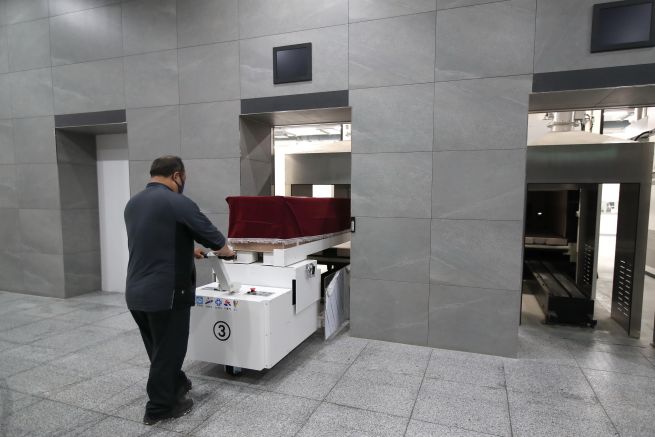
Cremation facilities at Hambaeksan Memorial Park in Hwaseong (Photo courtesy of the Hambaeksan Memorial Park website)
Since then, capacity has expanded. The Hambaeksan Memorial Park in Hwaseong increased its cremation furnaces from 13 to 18, raising daily capacity by nearly 50 percent. Seoul’s municipal crematorium also completed expansion work last August, boosting its daily processing ability from 59 to 85 cases.
As of mid-January, the national three-day cremation rate had rebounded to nearly 80 percent, according to government figures.
Still, families continue to report difficulties securing reservations — especially during preferred morning hours. Industry officials say the problem is less about total capacity than timing and geography.
“Most families want morning cremations to complete funeral rites the same day,” said one funeral hall manager. “When those slots fill up, it feels like there’s a shortage even though afternoon times remain available.”
Local residency rules also contribute to the perception. Many crematoriums give priority time slots and sharply discounted fees to residents of their own jurisdictions, leaving nonresidents with fewer options and higher costs.
Looking ahead, experts warn that today’s relative stability may not last.
According to the government’s long-term funeral infrastructure plan, annual deaths are projected to rise from about 310,000 in 2020 to nearly 700,000 by 2070. At the same time, cremation has become the dominant burial method, with the national cremation rate reaching 94 percent in 2024.
Despite plans to increase the number of cremation furnaces nationwide to 430 by 2027, the current total stands at about 410 — already a concern in fast-growing regions such as northeastern Gyeonggi Province, where population density is high but local facilities are scarce.
“On paper, the numbers may look sufficient,” said Park Tae-ho, co-chair of the Funeral and Cremation Culture Research Forum. “But regionally, shortages are real. In some areas, families still have to travel long distances for cremation.”
Park warned that prolonged cold spells or future epidemics could once again overwhelm the system unless capacity is expanded more evenly.
“For a society aging as quickly as Korea’s,” he said, “the question is not whether another crisis will come — but when.”
Lina Jang (linajang@koreabizwire.com)