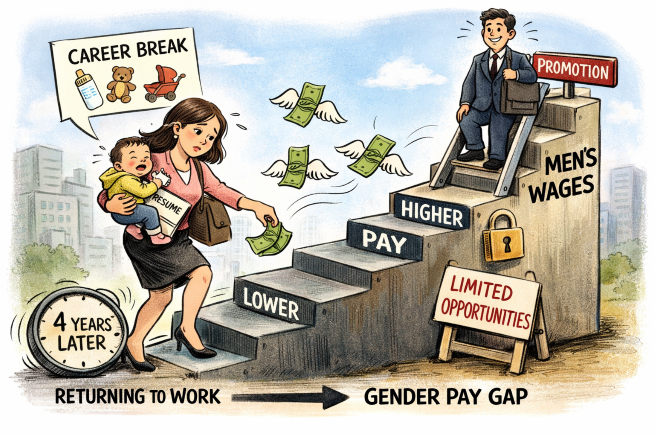
After Childcare Breaks, Women in Seoul Return to Work Earning Less, Study Finds (Image supported by ChatGPT)
SEOUL, Jan. 12 (Korea Bizwire) — Women in South Korea who leave the workforce due to pregnancy, childbirth or caregiving face persistent economic penalties when they return to work, with four in 10 earning less than before their career break, according to a new study released on Sunday.
The report, published by the Seoul Foundation of Women and Family, found that women who experienced career interruptions took an average of four years to secure new employment, more than twice as long as men.
Among women who successfully reentered the labor market, 42.5 percent said their wages declined after returning to work, compared with 25 percent of men who had similar career breaks.
The findings are based on a survey of 2,754 employed adults aged 19 to 64 living in Seoul, including 2,045 women and 709 men. Of those surveyed, 565 respondents — 513 women and 52 men — reported having left their jobs because of pregnancy, childbirth or caregiving responsibilities.
While a similar share of women and men reported earning higher wages after returning to work, women were far more likely to accept lower pay in exchange for improved work-life balance.
About 32 percent of women said their work-life balance improved after reemployment, compared with 15 percent of men. Researchers attributed this gap to women’s continued caregiving responsibilities, which often push them toward jobs with more flexible schedules but lower pay.
The study also highlighted broader gender disparities in the labor market. Women were less likely to hold regular, full-time positions, worked fewer hours on average and were more likely to be employed at smaller firms. Average monthly wages for women stood at 2.88 million won ($2,100), well below the 3.89 million won earned by men.
Women were also more likely to report experiencing negative workplace evaluations related to parental leave or reduced working hours.
The report concluded that career interruptions related to childbirth and caregiving remain a structural barrier for women, calling for Seoul’s employment policies to be redesigned to narrow gender gaps and address entrenched inequalities in the labor market.
Lina Jang (linajang@koreabizwire.com)