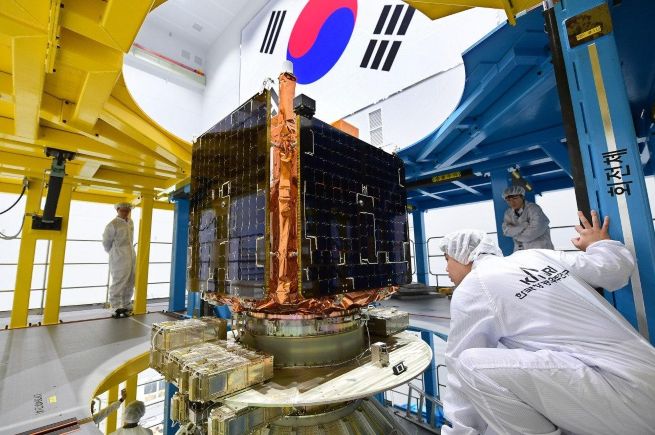
An image of the Next-Generation Medium-Sized Satellite No. 3 mounted on the third stage of the Nuri rocket (provided by the Korea Aerospace Research Institute).
SEOUL, Nov. 17 (Korea Bizwire) — South Korea’s Nuri rocket is set to lift off before dawn on Nov. 27 carrying 13 satellites, a diverse payload that underscores the country’s expanding ambitions in science, commercial space ventures and next-generation technology.
According to the Korea Aerospace Research Institute (KARI), the fourth Nuri launch will carry the 516-kilogram Next-Generation Mid-Sized Satellite No. 3 as its primary payload, alongside 12 cube satellites developed by companies, universities and research institutes.
Dawn launch timed for aurora science
The main satellite — built by Korea Aerospace Industries — is designed for space weather research and technology testing. It will study auroras and atmospheric airglow using a wide-field observation camera developed by the Korea Astronomy and Space Science Institute.
Another payload, KAIST’s IAMMAP instrument, will monitor plasma disturbances in Earth’s ionosphere, while Hallym University’s “Bio-Cabinet” will test stem-cell-based 3D printing and cell cultures in microgravity.
To capture the right sunlight conditions for aurora imaging, the satellite must enter orbit at 12:40 p.m. local solar time. That requirement forces a rare 1:04 a.m. launch from the Naro Space Center.
If successful, the mission will also mark a milestone for Korea’s satellite-mass-production program. Next-Generation Satellite No. 3 was built largely with domestically produced components to avoid U.S. export restrictions, a step researchers say increases Korea’s autonomy in future launches.
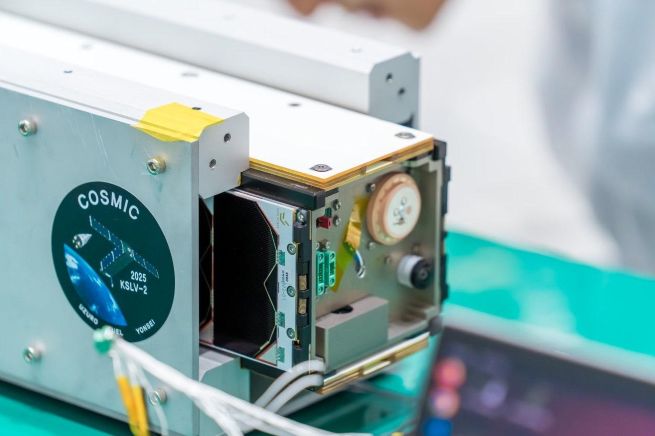
“Cosmic,” the satellite developed by UzuroTech (photo provided by the Korea Aerospace Research Institute).
Private cube satellites pursue bold experiments
Reflecting the country’s “new space” shift toward private-sector participation, several companies will send cube satellites into orbit free of charge through the mission.
-
Uzhurotech will test a propulsion-equipped satellite designed to deorbit itself — a demonstration of emerging space-debris-removal technologies.
-
Space LYNX will attempt the world’s first protein crystallization experiment aboard a cube satellite, aiming to crystalize pembrolizumab, the key ingredient in the blockbuster cancer drug Keytruda, in microgravity.
-
Hancom InSpace will launch its first independently developed Earth-observation satellite, Sejong-4.
-
CosmoWorks will send two imaging satellites, while Quarterneon will deploy a satellite to track marine waste around Jeju and the South Sea.
Public research institutions are also joining the mission. The Electronics and Telecommunications Research Institute (ETRI) will test 6G-related maritime IoT communications, while KARI and Naraspace will verify whether Korean-made semiconductor components — including Samsung DRAM and KAIST ASIC chips — function reliably in orbit.
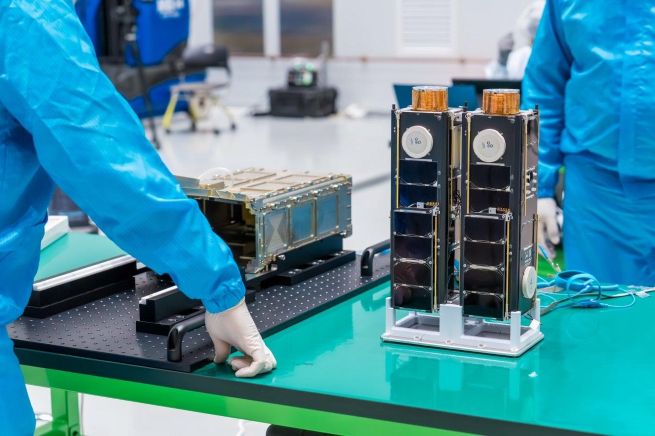
Seoul National University’s cube satellites “Duri” and “Hana” (photo provided by the Korea Aerospace Research Institute).
Universities aim for first-ever success after years of failures
Four university-built satellites, selected in a 2022 national competition, will also fly — with hopes high after all 15 cube satellites launched in earlier competitions failed to complete their full missions.
Seoul National University will send twin 3U satellites designed to separate, maneuver without thrusters and autonomously dock using only differences in atmospheric drag — a first for a Korean university mission.
KAIST will test a miniaturized Hall-effect thruster, Sejong University will verify low-orbit navigation and infrared ocean-plastic detection using a 2U satellite, and Inha University will trial rollable solar panels that unfurl in orbit.
Despite multiple previous attempts, none of Korea’s university cube satellites have fully succeeded in orbit. Engineers hope this year’s cohort — backed by more mature technology and tighter testing — may deliver the country’s first complete university-mission success.
The Nov. 27 launch will mark Nuri’s latest test as Korea pushes to strengthen its domestic launch capabilities and accelerate participation in the global space economy.
Kevin Lee (kevinlee@koreabizwire.com)