The South Korean government is considering a major overhaul of how it grants pension credits for childbirth and military service, moving from a system of post-retirement adjustments to upfront support . (Image courtesy of Yonhap)
SEOUL, Aug. 20 (Korea Bizwire) — The South Korean government is considering a major overhaul of how it grants pension credits for childbirth and military service, moving from a system of post-retirement adjustments to upfront support — a change that could save nearly 88 trillion won ($65 billion) in state finances over the long term, according to a state think tank.
The Ministry of Health and Welfare disclosed to lawmakers this week that it is reviewing the “advance support” model, under which the government would prepay a portion of National Pension Service (NPS) contributions at the time of childbirth or military duty, rather than covering the benefit decades later during retirement.
The plan aligns with a five-year national policy blueprint unveiled last week by the presidential planning committee.
Under current rules, credits for socially valuable activities — such as raising children or fulfilling mandatory military service — extend pension eligibility and boost retirement benefits, but are calculated only at the time of payout.
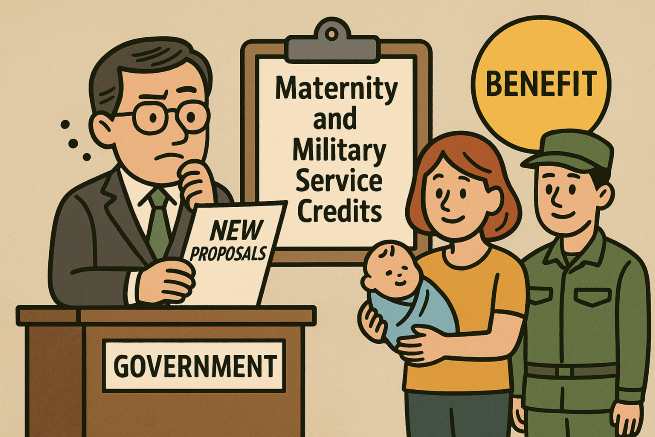
Pay Now, Save Later: Pension Reform Proposal Targets 88 Trillion Won in Long-Term Savings (Image supported by ChatGPT)
Research by the National Pension Research Institute shows that shifting the payments upfront would reduce overall fiscal costs by more than half, thanks to the NPS’s structure that typically pays retirees far more than they contributed.
For childbirth credits, projected costs would fall from 95.4 trillion won under the current model to 42.3 trillion won with upfront contributions. Military service credits would decline from 49.5 trillion won to 14.8 trillion won.
Still, the change would require greater near-term spending. If enacted in 2025, the government would need an estimated 363.7 billion won for childbirth credits and 194 billion won for military service credits in the first year alone.
Analysts caution that the shift would effectively transfer part of the financial burden from future generations to current taxpayers.
Eligibility would also broaden. Today, only those who eventually meet the 10-year minimum contribution period to receive pensions benefit from the credits.
An advance payment model would extend support to all who give birth or serve in the military, raising questions over how to handle contributions for people who later withdraw their savings as a lump sum.
The reform debate comes as Korea prepares to expand its credit system in 2026 under a revised pension law passed earlier this year. Starting then, the first child — previously excluded — will qualify parents for 12 months of additional contribution credits, while the cap of 50 months will be lifted to allow greater recognition for larger families.
Military service credits will also be adjusted to reflect the actual length of service, up to 12 months, rather than the flat six months currently granted.
Experts say the proposed advance support model offers a rare chance to reduce the NPS’s long-term fiscal pressures without diminishing individual benefits.
But they also warn that the policy’s immediate costs and new complexities around coverage and refund rules will require careful political and financial negotiation.
M. H. Lee (mhlee@koreabizwire.com)