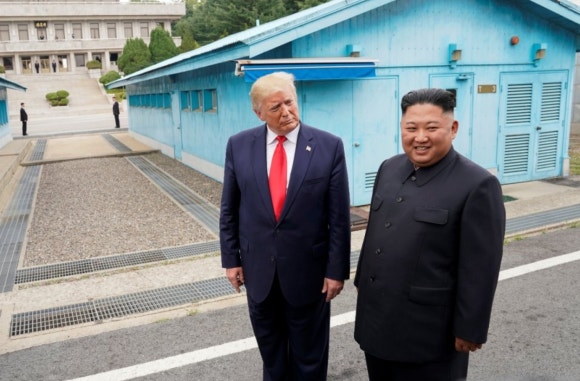
North Korean leader Kim Jong-un (R) and U.S. President Donald Trump across the Demarcation Line in the inter-Korean truce village of Panmunjom during their meeting on June 30, 2019
SEOUL, Sept. 22 (Korea Bizwire) — When North Korean leader Kim Jong-un told his parliament last weekend that he still holds a “good memory” of U.S. President Donald Trump, it was more than a nostalgic aside.
It was the first public hint in years that Pyongyang could contemplate returning to the table with Washington—provided, Kim insisted, that the United States abandons what he called its “hollow obsession” with denuclearization.
The remarks came just weeks before Trump is scheduled to visit South Korea for the Asia-Pacific Economic Cooperation summit in Gyeongju, raising speculation that the two men—who once redefined the theatrics of nuclear diplomacy—might stage a dramatic reunion.
Kim’s message was layered. While he dismissed outright the prospect of surrendering nuclear weapons, now constitutionally enshrined as “irreversible,” he left open a narrow channel for talks rooted in “peaceful coexistence” with Washington.
His suggestion, paired with the unexpected note of personal warmth toward Trump, was enough to ignite chatter in diplomatic circles.
For Trump, the overture presents a familiar stage. Since returning to the White House this year, he has repeatedly touted his “great relationship” with Kim, invoking the chemistry that produced their high-profile summits in Singapore in 2018 and Hanoi in 2019, as well as the fleeting handshake at Panmunjom that same year.
The encounters were rich in symbolism but yielded little substance; the Hanoi talks collapsed over differences on sanctions and nuclear concessions.
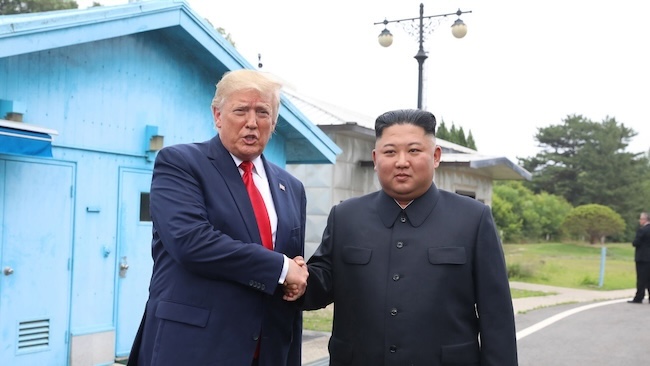
This photo, taken on June 30, 2019, shows then U.S. President Donald Trump (L) shaking hands with North Korean leader Kim Jong-un at the inter-Korean border truce village of Panmunjom. (Image courtesy of Yonhap)
Kim Jong-un’s ‘Good Memory’ of Trump Revives Talk of a Diplomatic Encore
Whether the two leaders will reprise their summitry next month remains uncertain. Kim is not expected to attend the APEC gathering himself, but analysts note that a side meeting—perhaps again at Panmunjom—cannot be ruled out.
Still, the obstacles remain formidable. Kim has reaffirmed his absolute rejection of denuclearization negotiations, while Trump’s administration continues to uphold the goal officially, even as Trump himself has at times described North Korea as a “nuclear power.”
That apparent contradiction leaves open the question of whether Washington would quietly shift its approach to secure another breakthrough moment.
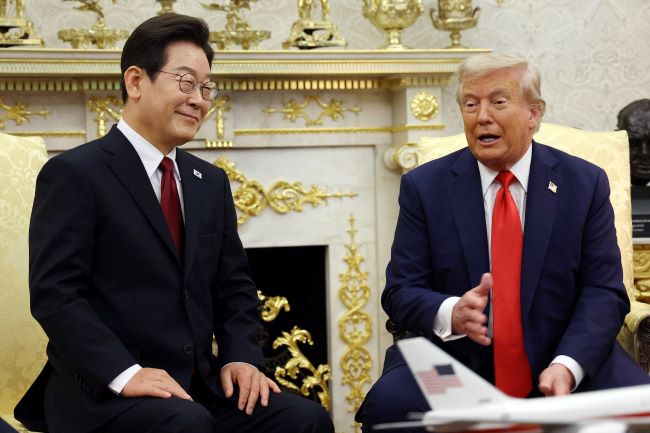
South Korean President Lee Jae Myung (L) holds talks with U.S. President Donald Trump in the Oval Office of the White House in Washington on Aug. 25, 2025. (Image courtesy of Yonhap)
In Seoul, President Lee Jae Myung has signaled readiness to support a more flexible strategy. Speaking to the BBC, Lee said his government could accept an interim deal that freezes North Korea’s weapons production rather than eliminates its arsenal—an acknowledgment that the all-or-nothing pursuit of denuclearization may have reached a dead end.
Experts caution, however, that progress depends almost entirely on Trump’s calculus. “A meeting between the leaders of North Korea and the U.S. will likely depend on whether Trump makes a decision,” said Lim Eul-chul, a professor at Kyungnam University’s Institute for Far Eastern Studies. “But unless North Korea’s insistence on nuclear arms changes, a fundamental resolution will not come easily.”
For now, Kim’s professed “good memory” of Trump offers a rare glimmer of familiarity in a fraught standoff. Whether it becomes the basis for renewed diplomacy—or simply another reminder of what was left unfinished in Hanoi—may be tested in the weeks ahead.
M. H. Lee (mhlee@koreabizwire.com)