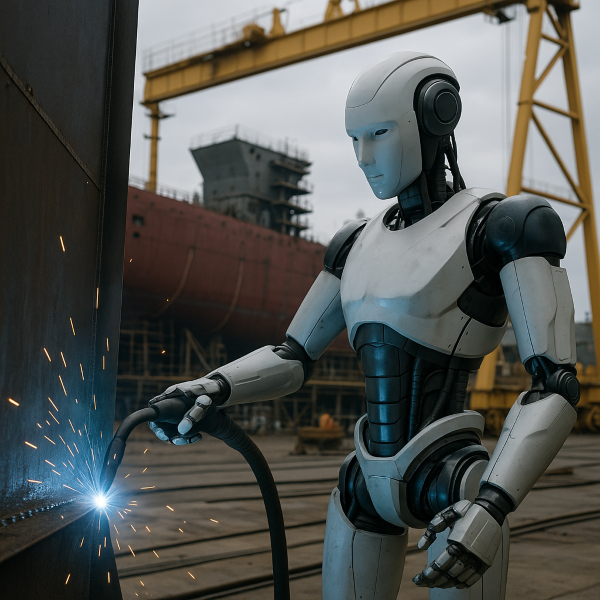
HD Hyundai to Build South Korea’s First Welding Humanoid Robot for Shipyards (Image created by ChatGPT)
SEOUL, May 8 (Korea Bizwire) — HD Hyundai is embarking on a pioneering effort to develop South Korea’s first humanoid robot specialized in welding, teaming up with leading AI and robotics companies to advance automation in shipbuilding.
The company announced Wednesday that its subsidiaries — HD Korea Shipbuilding & Offshore Engineering and HD Hyundai Robotics — have signed a memorandum of understanding in Houston with U.S.-based humanoid robotics firm Persona AI and robotic systems developer Basil Company.
The partnership aims to create an AI-powered humanoid capable of performing precision welding in shipyards, enhancing both productivity and worker safety.
Under the agreement, HD Hyundai Robotics will contribute AI-based welding automation technologies and oversee performance validation of the robot. HD Korea Shipbuilding will provide real-world shipyard environments for testing and offer technical and data support for field deployment.
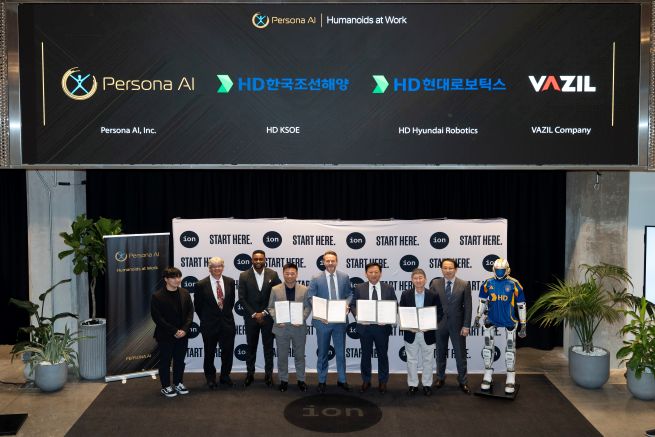
HD Hyundai Teams Up with U.S. Robotics Firms to Develop AI Welding Humanoid (Image provided by HD Hyundai)
Persona AI will lead hardware development and implement AI algorithms for robotic control and machine learning, while Basil Company will design and test welding tools to be integrated into the humanoid platform and build the testing infrastructure.
The consortium plans to complete a prototype by 2026, with field trials and commercialization expected to begin in 2027.
“This initiative will define a new paradigm for shipyard automation,” an HD Hyundai official said in a statement. “Our goal is to engineer a humanoid perfectly optimized for shipbuilding operations.”
Persona AI CEO Nick Radford called the collaboration “a significant challenge and opportunity,” noting that applying AI to shipbuilding’s core processes represents a meaningful shift toward smart industrial environments. Basil Company CTO Kim Sung-won added that the project will elevate the precision and automation capabilities of the global shipbuilding sector.
If successful, the project could mark a major leap forward for the Korean shipbuilding industry as it seeks to remain competitive amid global labor shortages and rising safety standards.
Ashley Song (ashley@koreabizwire.com)