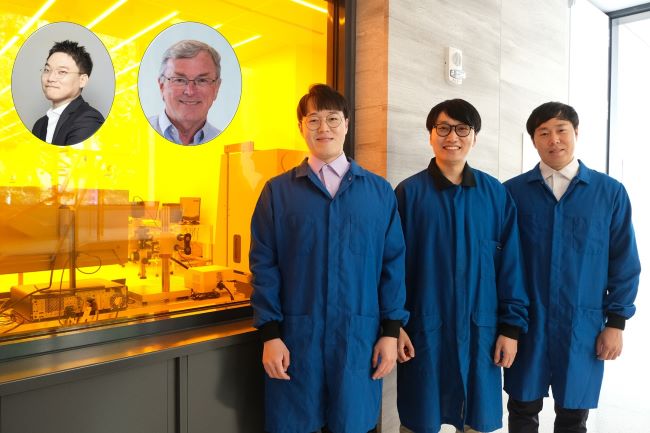
KAIST–MIT collaborative research team [Image courtesy of KAIST)
SEOUL, Aug. 26 (Korea Bizwire) — Researchers at the Korea Advanced Institute of Science and Technology (KAIST) and the Massachusetts Institute of Technology (MIT) have developed a new fiber-based material that can capture carbon dioxide directly from the air using only small amounts of electricity, potentially lowering the barriers to large-scale deployment of direct air capture (DAC) technology.
DAC systems, which remove carbon dioxide directly from ambient air, have long been hindered by their high energy requirements. With atmospheric CO₂ concentrations at less than 400 parts per million, vast volumes of air must be processed, typically requiring large amounts of heat.
The joint team, led by Professor Ko Dong-yeon of KAIST’s Department of Chemical and Biomolecular Engineering and Professor T. Alan Hatton of MIT’s Department of Chemical Engineering, overcame this limitation by designing an electrically conductive fiber adsorbent that heats itself through Joule heating.
The material can reach 110 degrees Celsius in just 80 seconds using a low voltage of three volts — roughly equivalent to charging a smartphone.
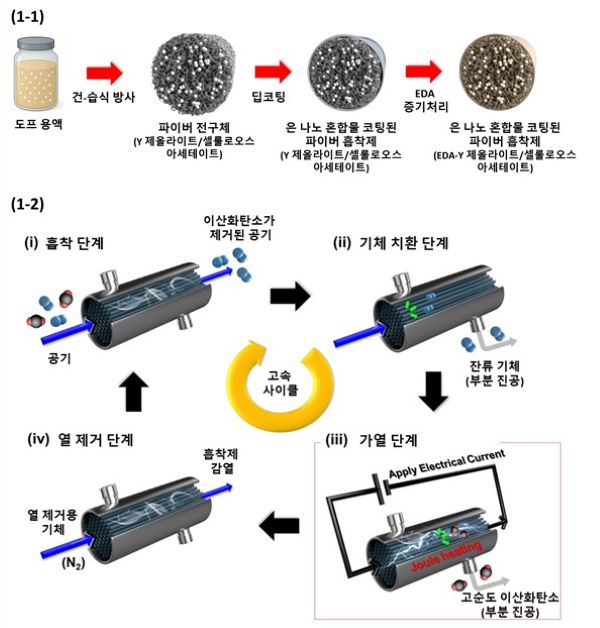
The research team’s breakthrough technology enables efficient CO₂ capture. (Image courtesy of Yonhap)
The fiber is coated with a three-micrometer-thick layer of silver nanowires and nanoparticle composites, creating a porous structure that allows carbon dioxide molecules to pass through efficiently while enabling rapid, uniform heating. When connected in parallel, the fibers’ resistance drops below one ohm, demonstrating scalability for larger systems.
In real-world tests, the material captured and released carbon dioxide at purities above 95 percent. Because it operates entirely on electricity, it could be powered by renewable sources such as solar and wind energy, making it a promising fit for decarbonization strategies.
The project, launched in 2020, has now resulted in patent filings in multiple jurisdictions. “Direct air capture enables not just the reduction of emissions but the purification of air itself — what we call ‘negative emissions,’” Professor Ko said. “Our next step is to move beyond the lab toward commercialization.”
The research was published online this month in the journal Advanced Materials.
Kevin Lee (kevinlee@koreabizwire.com)