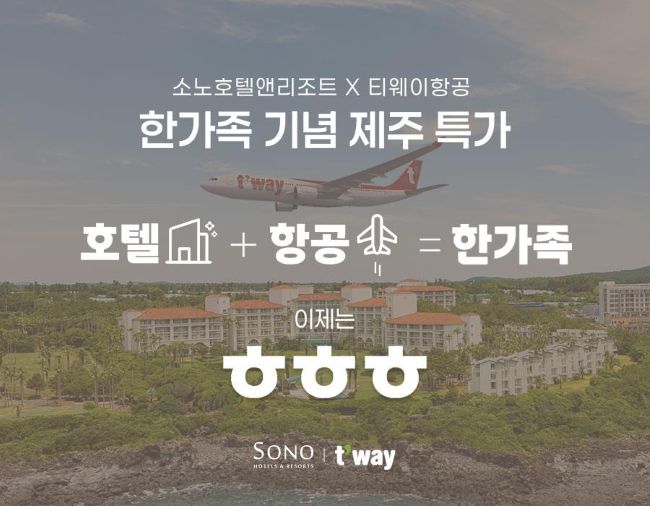
Now We’re One Family Promotion (Flight + Hotel = One Family) To celebrate the partnership between Sono International and T’way Air, a special travel package to Jeju Island is being offered. (Image courtesy of Sono International)
SEOUL, July 22 (Korea Bizwire) — South Korea’s mid-sized and smaller business groups are increasingly leveraging mergers and acquisitions (M&A) to expand their reach, diversify services, and create synergies between legacy businesses and emerging growth engines — from hospitality and aviation to cosmetics, food tech, and education.
Recent deals underscore how cross-sector integration is reshaping industries. Daemyung Sono Group, which acquired low-cost carrier T’way Air last month, launched its first bundled promotion this July. Under the “Air + Hotel = One Family” campaign, customers flying T’way to Jeju and staying at Sono hotels receive discounts and complimentary amenities, part of a broader push to combine its extensive global resort infrastructure with air travel.
Travel platform Yanolja, after acquiring Interpark in 2022, merged it with its subsidiary to form NOL Universe, a brand that now spans outbound, domestic, and inbound tourism.
A signature product, Play & Stay, targets foreign visitors by bundling K-pop concert tickets with hotel stays and shuttle service — an offering that drove a 2.5-fold increase in users and 3.3-fold rise in sales year-over-year.

Amorepacific Acquires COSRX as a Subsidiary. (Image courtesy of Amorepacific)
In the beauty sector, Amorepacific fully acquired skincare brand COSRX in 2023 after years of investment, with co-developed products like Vitamin C and Retinol serums gaining traction overseas.
Meanwhile, LG Household & Health Care acquired LG Pra.L, a beauty tech brand previously owned by LG Electronics, signaling a serious move into beauty devices.
Other firms are expanding into adjacent sectors. Woongjin, a major education company, acquired funeral service provider Preed Life last month as part of its ambition to evolve into a “total life care” enterprise spanning education, leisure, and healthcare.
Hanwha Hotels & Resorts, which took over food service company Ourhome in May, is now developing automated meal solutions and expanding food distribution in partnership with its subsidiary Hanwha Foodtech.
However, M&A activity has also raised concerns over job security and workplace restructuring. Prior to its acquisition, Ourhome faced criticism following a factory accident and rumors of mass layoffs. In response, the company signed an employment stability agreement with its labor union. Woongjin, too, has promised full employee retention at Preed Life.
To maintain continuity, some acquired firms are allowed operational independence. COSRX, for instance, continues to run autonomously under Amorepacific’s umbrella, with no changes in top management.
Even with successful integrations, some labor issues remain. At NOL Universe, efforts to unify welfare policies between Yanolja and Interpark have sparked negotiations with labor unions over benefit enhancements and flexible work policies.
As more mid-sized companies pursue strategic M&As to navigate economic uncertainty and unlock long-term value, balancing corporate synergies with employment stability will remain a defining challenge in Korea’s evolving business landscape.
M. H. Lee (mhlee@koreabizwire.com)