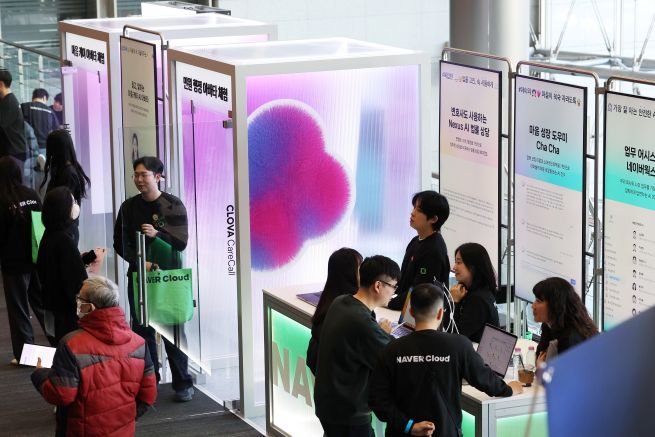
Attention is turning to Naver’s next moves in artificial intelligence after the company failed to advance past the first evaluation round of the government’s independent AI foundation model project. The photo shows attendees visiting the Naver Cloud booth at the project’s first-stage briefing held on Dec. 30 at COEX in Seoul’s Gangnam district. (Yonhap)
SEOUL, Jan. 30 (Korea Bizwire) — Two major South Korean technology companies that were not selected for the government’s sovereign artificial intelligence initiative said Thursday that the experience nonetheless strengthened their technical capabilities and clarified the challenges of building foundational AI models.
Speaking at a New Year gathering for the artificial intelligence and software industry in Seoul, Kim Yoo-won, chief executive of Naver Cloud, said the company had hoped for a different outcome in the government’s independent AI foundation model project, known as “Dokpamo,” but emphasized the progress achieved through the effort.
“Our goal was to build a practical model,” Kim said, noting that Naver Cloud focused on developing a mid-sized multimodal AI system. He added that the model has received favorable evaluations on global benchmarking indexes, calling the project a meaningful technological accomplishment.
Kim said the company has since returned its focus to expanding real-world AI applications, citing recent discussions with the Bank of Korea on the development of an AI platform. Such collaborative efforts, he argued, represent the true path toward building sovereign AI capabilities.
Kim Min-jae, chief technology officer of NC AI, echoed similar sentiments, saying the company had hoped to contribute more directly to the government-led initiative but gained valuable experience nonetheless.
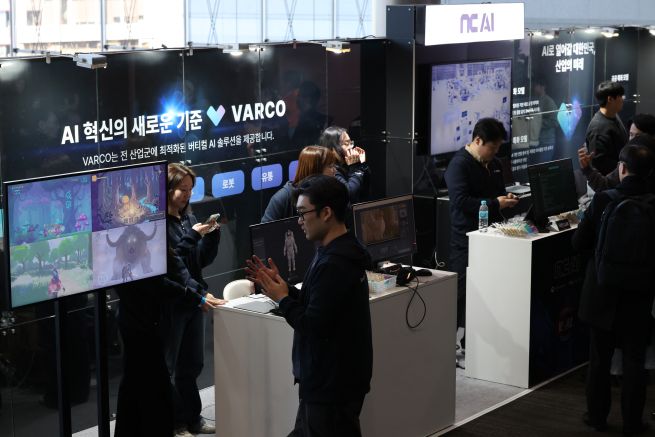
Attendees look around the NC AI booth at the first briefing session for the “Sovereign AI Foundation Model” project, held on Dec. 30 last year at COEX in Gangnam District, Seoul. (Yonhap)
“The project helped us fully realize how difficult — and how important — it is to develop independent AI technologies,” he said, adding that NC AI plans this year to concentrate on deploying AI solutions that can drive tangible change across industry and society, particularly in manufacturing and cultural content.
The event was also attended by Deputy Prime Minister and Science and ICT Minister Bae Kyung-hoon, who stressed the central role of software in the advancement of emerging technologies, including quantum computing and physical AI.
Drawing parallels to Nvidia’s dominance of the global GPU ecosystem through its CUDA software platform, Bae said South Korea could leverage its software strengths to become a global leader in physical AI, artificial intelligence and quantum technologies.
He said building a robust software ecosystem — spanning operating systems, large-scale systems and integrated pipelines — would be essential for Korea to differentiate itself in robotics and physical AI.
Despite debate surrounding the Dokpamo project, Bae said the initiative had demonstrated meaningful potential, adding that participating companies — whether selected or not — were producing results with global significance.
The remarks reflected both the growing ambitions and the structural challenges facing South Korea as it seeks to establish technological sovereignty in an increasingly competitive global AI landscape.
Kevin Lee (kevinlee@koreabizwire.com)