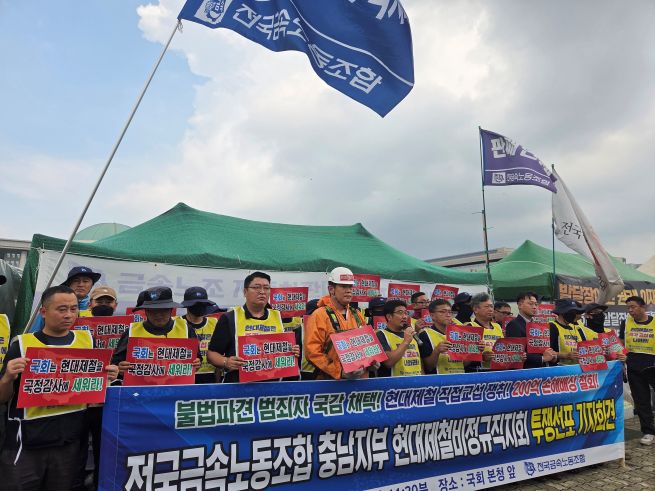
On August 25, non-regular workers at Hyundai Steel demanded direct employment from the parent company. At a press conference held the day after the National Assembly passed the Yellow Envelope Law (amendments to Articles 2 and 3 of the Trade Union Act), they declared, “Hyundai Steel, the real employer, must negotiate with non-regular workers.” (Yonhap)
SEOUL, Aug. 25 (Korea Bizwire) — A sweeping change to South Korea’s labor law is already fueling a surge of demands from subcontractor unions, rattling the country’s largest corporations and raising fears of escalating industrial conflict.
On August 24, parliament passed the so-called “Yellow Envelope Law,” an amendment to the Trade Union and Labor Relations Adjustment Act pushed through by the ruling party.
The law broadens the definition of “employer,” allowing subcontracted workers to press the parent company — even without a direct contract — for wage, welfare, and working-condition negotiations.
It also limits companies’ ability to seek damage claims against individual workers involved in illegal strikes, restricting liability to collective union responsibility.
Labor groups have seized on the change to demand direct talks with corporate giants across industries that rely heavily on subcontractors, from semiconductors and automobiles to shipbuilding and retail.
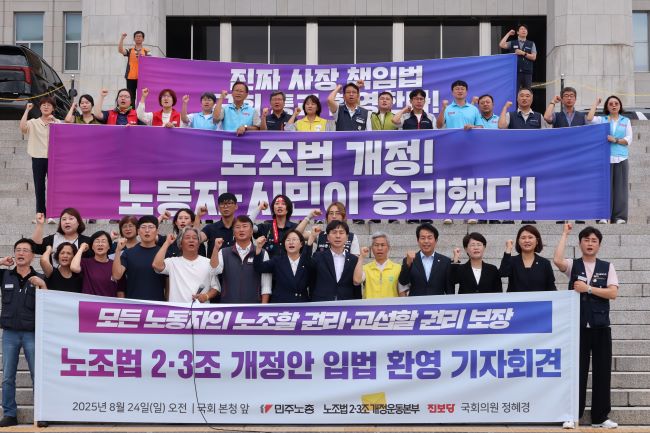
Korean labor groups celebrate the National Assembly’s approval of the pro-labor Yellow Envelope Bill. (Image courtesy of Yonhap)
At Samsung Electronics, a union representing a subcontractor, ENS, has called on the tech giant to intervene in disputes over back pay and delayed wages.
At Hyundai Steel, subcontractor workers staged a rally outside the National Assembly demanding direct negotiations and withdrawal of damage suits.
Unions tied to Naver’s subsidiaries plan a demonstration at the company’s headquarters later this month, while shipbuilding unions have urged collective bargaining with HD Hyundai and Hanwha Ocean.
Other cases are emerging in construction and retail. Workers at SK hynix’s Cheongju plant site, built by SK ecoplant, have asked the parent company to address dismissals of subcontracted employees.
The retail services union is pressing department store operators Lotte, Shinsegae, and Hyundai to negotiate directly over staffing and scheduling.
Business leaders warn of confusion and unintended consequences. A senior auto executive said, “The law is too ambiguous — we can’t even tell who the legal employer is, but subcontractor unions are already making demands.”
Industry groups argue the law could worsen subcontracting conditions, as strikes by one supplier risk spilling over and hurting hundreds of others in tightly interlinked production chains.
Labor advocates counter that the reform corrects long-standing imbalances that left subcontracted workers with little leverage. But corporations are bracing for what could become a new era of labor unrest in some of South Korea’s most strategically important industries.
M. H. Lee (mhlee@koreabizwire.com)