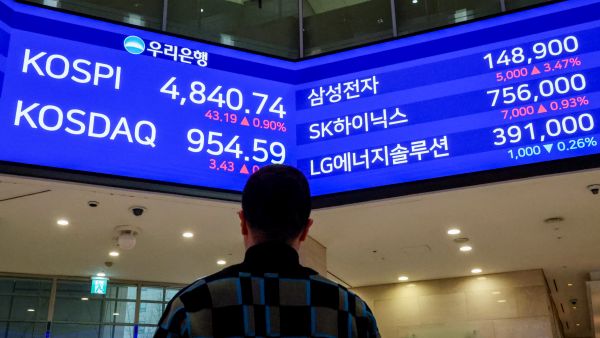
On Jan. 16, financial display boards in the lobby of Woori Bank’s headquarters in Jung-gu, Seoul, show the KOSPI and KOSDAQ indices. (Yonhap)
SEOUL, Jan. 19 (Korea Bizwire) — South Korea’s benchmark KOSPI surged nearly 15 percent in early January, but the gains were unevenly distributed, with industrial and capital-intensive sectors leading the rally while consumer-related stocks lagged behind.
According to data from the Korea Exchange, the transport equipment and auto parts sector posted the strongest performance between Jan. 2 and Jan. 16, rising 27.0 percent — well above the broader market’s 14.9 percent gain over the same period.
Machinery and equipment shares climbed 22.6 percent, followed by construction at 21.7 percent, electronics at 19.3 percent, manufacturing at 19.1 percent and securities firms at 16.8 percent.
The transport equipment category includes major exporters and defense-related manufacturers such as Hyundai Motor, Kia, Hyundai Mobis, Hanwha Aerospace, Hanwha Ocean and HD Hyundai Heavy Industries. Investor demand rotated into autos, shipbuilding and defense stocks as large semiconductor shares paused briefly after a strong run.
Hyundai Motor drew particular attention after unveiling its humanoid robot, Atlas, at CES 2026 in Las Vegas earlier this month. The automaker’s shares jumped more than 34 percent between Jan. 6 and Jan. 16.

Global Media Spotlight Hyundai’s Shift From Automaker to Robotics Powerhouse (Image courtesy of Hyundai Motor)
Construction stocks, which had lagged amid a prolonged domestic property slowdown, rebounded on expectations of large-scale infrastructure spending at home and increased overseas orders, including nuclear power projects. Brokerage shares also advanced sharply on expectations of improved earnings fueled by heightened trading activity.
By contrast, several consumer-oriented sectors underperformed or declined despite the market rally. Non-metallic minerals fell 3.0 percent, textiles and apparel dropped 2.8 percent, paper and wood slid 2.8 percent, while food and tobacco edged down 0.9 percent. Analysts attributed the weakness to currency pressures and concerns over input costs and consumer demand.
Market strategists said the rally reflected active sector rotation rather than broad-based optimism.
“Investors are rotating toward industries that appear undervalued relative to earnings,” said Jung Hae-chang, an analyst at Daishin Securities, adding that pullbacks in market leaders may offer opportunities to increase exposure.
Han Ji-young of Kiwoom Securities cautioned that fatigue may be building after consecutive gains, raising the risk of short-term corrections. She suggested that overlooked sectors such as hotels, leisure, cosmetics and retail could attract renewed interest in the coming weeks.
As the January rally continues, analysts say the sustainability of gains will hinge on earnings momentum and whether investor confidence can extend beyond a narrow group of industrial leaders.
Ashley Song (ashley@koreabizwire.com)