Visitors to Seoul’s Namsan Observatory look out over a cityscape packed with apartment buildings. (Yonhap)
SEOUL, Feb. 12 (Korea Bizwire) — South Korea’s government said on Thursday it would allow a short grace period of up to six months for owners of multiple homes, even as it presses ahead with plans to end a temporary exemption from punitive capital gains taxes in May.
The Ministry of Economy and Finance said the exemption will expire as scheduled on May 9, underscoring President Lee Jae Myung’s campaign pledge to tame housing prices and rein in speculation, particularly in the Seoul metropolitan area, where property values have surged.
But in a nod to market concerns, the ministry introduced limited flexibility. Owners in Seoul’s high-priced Gangnam and Yongsan districts will be granted a four-month grace period, while properties in newly designated speculative zones will receive up to six months. The extension applies to transactions in which final payments are completed or ownership registration is finalized within that time frame.
“To ensure policy predictability and credibility, the exemption will end as originally scheduled,” the ministry said in a statement. “At the same time, supplementary measures have been prepared to improve consistency between systems and minimize public inconvenience.”
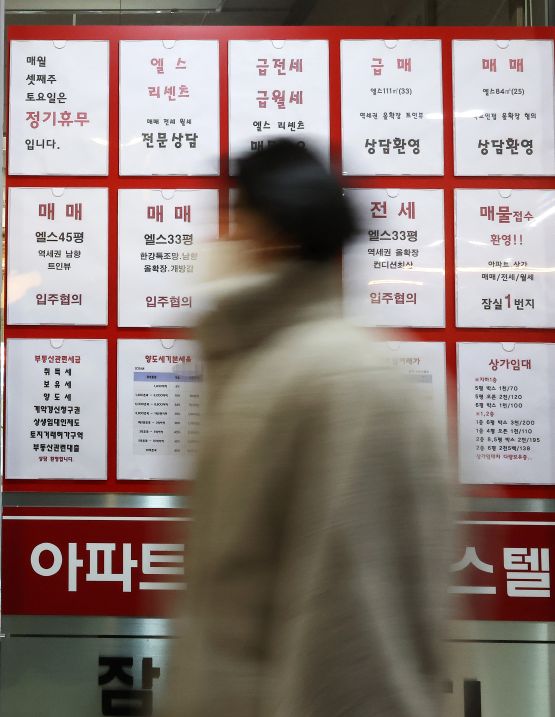
Notices detailing real estate–related taxes and apartment listings are posted on the glass wall of a licensed real estate agency office in Jamsil, Seoul. (Yonhap)
The looming expiration has already prompted many multiple-property owners to list homes for sale to avoid steep tax bills. Under current rules, capital gains taxes range from 6 percent to 45 percent. In designated speculative areas, owners of two homes face an additional 20-percentage-point surcharge; those with three or more properties are subject to a 30-point surcharge on top of the base rate.
The government also said it would temporarily ease certain owner-occupancy requirements under the land transaction permit system for homes currently leased to tenants. Many rental properties operate under South Korea’s jeonse system, in which tenants provide a large lump-sum deposit that is returned at the end of a two-year lease, complicating immediate sales.
Housing affordability has emerged as a defining issue for the Lee administration. The president has argued that runaway home prices are discouraging young people from marrying and starting families, exacerbating the country’s demographic crisis.
By holding firm on the tax rollback while offering a narrow transition window, the government is attempting to balance market stability with political resolve — a calculation that will be closely watched in a property market long prone to sharp swings.