Survey Shows Koreans Trust YouTube News — Even When It Isn’t From Newsrooms (Image supported by ChatGPT)
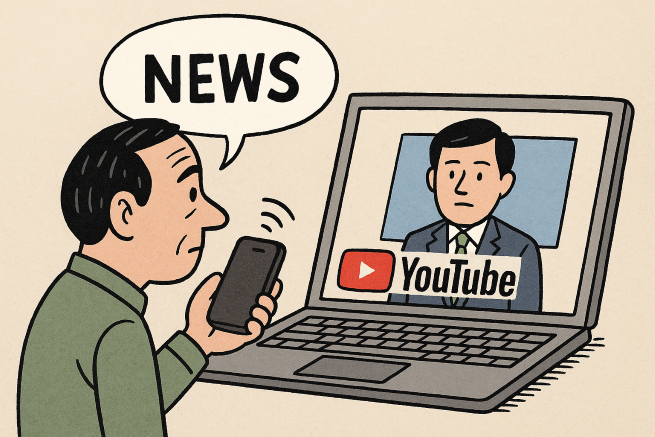
SEOUL, Dec. 5 (Korea Bizwire) — More than half of South Koreans watch news on YouTube every day, and a growing share now views content produced by non-traditional creators — individuals and small businesses — as legitimate news media, according to new research presented at a national policy forum on Thursday.
The survey, conducted in August with 1,000 adults, found that 52.1 percent of respondents consume YouTube news content daily, while nearly 90 percent watch such content at least three times a week. The most common daily viewing time was one to three hours.
A striking 82.4 percent of respondents said they regard YouTube news produced by established media outlets as journalism. But nearly half — 44.9 percent — also said that content produced by independent creators or commercial operators qualifies as “news media,” underscoring YouTube’s rapidly expanding role in the country’s information ecosystem.
The findings were presented by Pyo Si-young, a media studies professor at Kangwon National University, during a panel hosted by the Korea Press Arbitration Commission on how to modernize the Press Arbitration Act in the age of YouTube news.
Respondents pointed to several factors that make YouTube content feel like journalism: public-interest value (93 percent), the expertise of presenters (90.5 percent), and evidence of independent reporting (89 percent). Regular content schedules (90.8 percent) and professional editing quality (90.2 percent) also strongly influenced perceptions of legitimacy.
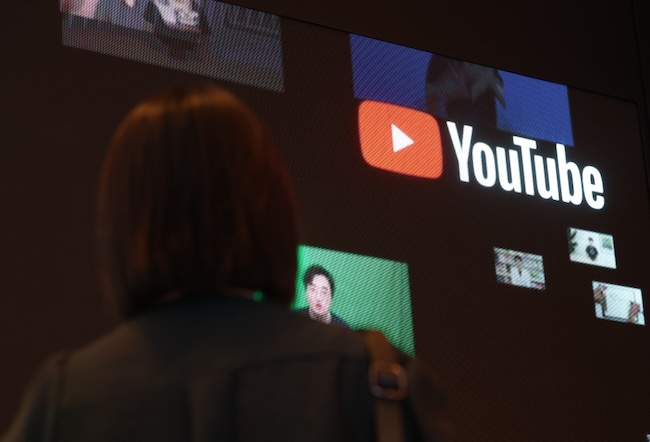
A South Korean appeals court has upheld a fine against a YouTuber who was charged with defaming another content creator during a livestream that had only one viewer. (Image courtesy of Yonhap)
At the same time, the public expressed significant concern about defamation, insults and privacy violations stemming from YouTube news. An overwhelming 93.2 percent said victims need formal avenues for redress through the Press Arbitration Commission.
Pyo argued that since YouTube channels already function as de facto media outlets — and the public perceives them as such — the law should be revised so that channels meeting objective standards are incorporated into the official dispute-resolution system.
A second presenter, Yang Jae-gyu of the Press Arbitration Commission, noted that the number of arbitration cases involving YouTube channels has jumped from 14 in 2022 to 54 this year, yet the rate of successful mediation remains about 12 percentage points lower than for traditional media cases.
Commission chair Choi Wan-joo reinforced the call for legal reform, saying YouTube news now rivals — and in some cases surpasses — newspapers and broadcasters in influence, while the country’s rights-protection framework has not kept pace.
Lina Jang (linajang@koreabizwire.com)