
The tiger character Duffy and the protagonist Lumi from K-Pop Demon Hunters. President Lee Jae-myung of South Korea cited the tiger ‘Duffy’ and the Grim Reaper as the most striking characters. Tigers once thrived across the Korean Peninsula, but indiscriminate hunting led by the Japanese during the colonial era drove them to extinction in Korea. (Image courtesy of Netflix)
JEJU, South Korea, Aug. 25 (Korea Bizwire) — As Netflix’s animated sensation K-Pop Demon Hunters races toward becoming the platform’s most-watched film, the spotlight has unexpectedly turned to Jeju Island, where viewers have identified cultural symbols embedded in the show’s storyline. Local voices are urging the island to seize the moment to promote its unique heritage alongside its famed natural landscapes.
The film, which follows a girl group of K-pop idols moonlighting as demon hunters, has amassed more than 210.5 million views in just nine weeks, trailing Netflix’s all-time leader Red Notice by only 20.4 million.
Its success has sparked demand for merchandise tied to Korean traditions — from tiger and magpie mascots to goods featuring gat hats and norigae ornaments — much of it selling out.
Fans believe key scenes in the film are set in Jeju, citing details such as stone-wall tombs known as sandam and the appearance of the island’s iconic stone guardians, dol hareubang. One character’s weapon even resembles the shingeom, a ritual blade used in shamanistic ceremonies still practiced on Jeju.

A sandam, a traditional Jeju stone-wall tomb, as depicted in the background of K-Pop Demon Hunters (Image source: Netflix animation K-Pop Demon Hunters)
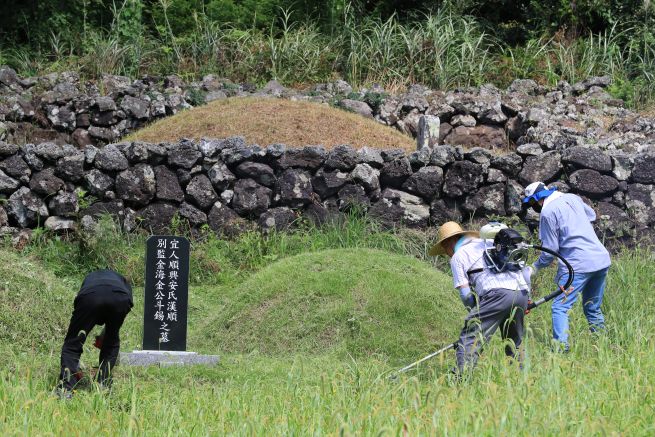
The burial practice of building stone walls, called sandam, around tombs is unique to Jeju. The photo shows a traditional Jeju tomb surrounded by a sandam stone wall. (Photo courtesy of Yonhap)
The island’s deep-rooted spiritual traditions, including UNESCO-recognized shamanic rites like the Chilmeoridang Yeongdeunggut, remain central to its identity. Yet critics note Jeju has been slow to capitalize on the global popularity of K-Pop Demon Hunters.
Planned tie-ins so far are limited to small activities at a local K-wave festival in September, such as mask-making and costume photo booths.
That hesitation has drawn comparisons to missed opportunities: last year’s hit series When Life Gives You Tangerines was set in 1950s Jeju but filmed largely elsewhere due to delays in building local sets. Other dramas, such as Welcome to Samdal-ri and Extraordinary Attorney Woo, successfully leveraged Jeju backdrops, which remain popular tourist draws.
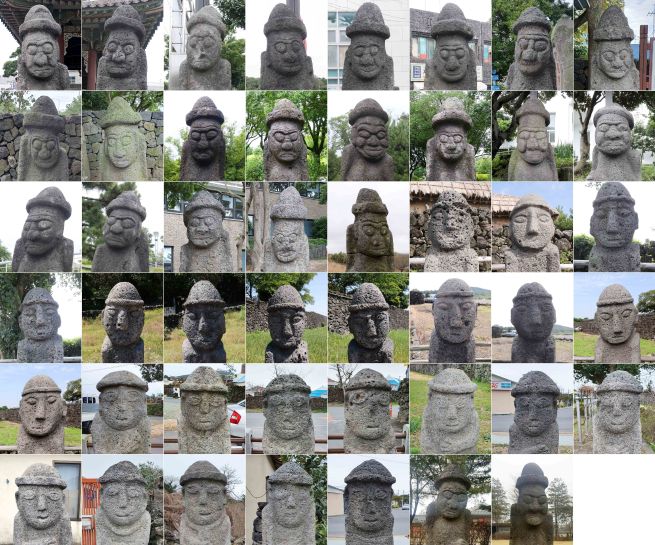
Dol hareubang are Jeju’s most iconic symbol. Traditionally, islanders regarded them as guardian deities that warded off evil spirits and granted wishes. The photo is a composite image of the 47 surviving dol hareubang, provided by the Jeju World Heritage Center. In the Joseon Dynasty, a total of 48 were erected outside the gates of major fortresses, but one has since disappeared. (Photo courtesy of Yonhap)
Industry observers say K-Pop Demon Hunters presents Jeju with another rare opening to align its cultural heritage with the surging global Hallyu wave. “We are pursuing overseas marketing using the show,” an official from the Jeju Tourism Organization said. “We will also work to develop tourism products that showcase Jeju’s culture featured in the film.”
Lina Jang (linajang@koreabizwire.com)