

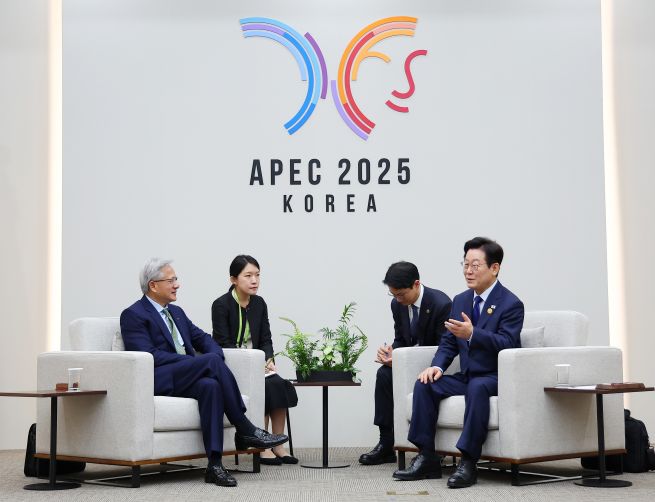
President Lee Jae Myung meets with Nvidia CEO Jensen Huang at the APEC summit venue, the HICO Convention Center in Gyeongju, on October 31. (Yonhap)
SEOUL, Nov. 2 (Korea Bizwire) — Nvidia Corp. has agreed to supply 260,000 of its high-performance graphics processing units (GPUs) to the South Korean government and four of the country’s leading conglomerates—Samsung Electronics, SK Group, Hyundai Motor, and Naver—in one of the largest AI hardware deals ever signed.
The agreement, finalized during a meeting Friday between Nvidia Chief Executive Jensen Huang and President Lee Jae Myung on the sidelines of the Asia-Pacific Economic Cooperation (APEC) summit in Gyeongju, underscores South Korea’s growing role in the global artificial intelligence race.
The meeting was also attended by Samsung Chairman Lee Jae-yong, SK Group Chairman Chey Tae-won, Hyundai Motor Group Executive Chair Euisun Chung, and Naver founder Lee Hae-jin.
Under the deal, each of the four companies and the government will receive 50,000 GPUs, while Naver Cloud will secure 60,000 units, according to Nvidia. The chips—part of Nvidia’s latest Blackwell series—will serve as the computational backbone for South Korea’s push into “sovereign AI,” a government-led initiative to develop domestic large language models and reduce reliance on foreign platforms.
Huang praised Korea’s industrial ecosystem as “unmatched anywhere in the world,” saying the country “can become the global center of AI.”
Samsung plans to use the GPUs to power an “AI semiconductor factory,” where artificial intelligence systems will oversee chip design and production from start to finish. SK Group will deploy its allotment to advance semiconductor research, cloud computing, and AI agent development, while Hyundai Motor will build an “AI mobility factory” to train next-generation models for autonomous vehicles and robotics.
Naver Cloud, meanwhile, will create a “physical AI platform” to digitally replicate industrial environments such as shipyards and semiconductor plants.
The deal, valued at roughly 14 trillion won ($10 billion), is expected to ease Korea’s GPU shortage and accelerate the Lee administration’s goal of making the country one of the world’s top three AI powers. GPUs are essential for training large-scale AI models, and their scarcity has hampered development worldwide amid a surge in global demand.
The agreement also deepens the integration between Nvidia and South Korea’s semiconductor giants. Samsung Electronics and SK Hynix are key suppliers of high-bandwidth memory (HBM) chips used in Nvidia’s GPUs.
Industry analysts estimate that more than two million HBM units from the two companies could be used to fulfill the deal, bolstering their positions in the next-generation HBM4 market.
For Nvidia, the partnership strengthens its foothold in Asia as it seeks to diversify beyond China, where U.S. export restrictions have slashed its market share for advanced chips. “I don’t need to choose between them,” Huang said of Samsung and SK Hynix at a press briefing. “We need both—and I’m 100 percent confident we’ll develop HBM4, HBM5, and beyond together as long-term partners.”
Kevin Lee (kevinlee@koreabizwire.com)


The concept of an “AI semiconductor factory” run by AI designing semiconductors for AI… that’s a full loop of technological self-evolution. Almost feels like Korea is building the first step toward automated intelligence infrastructure.