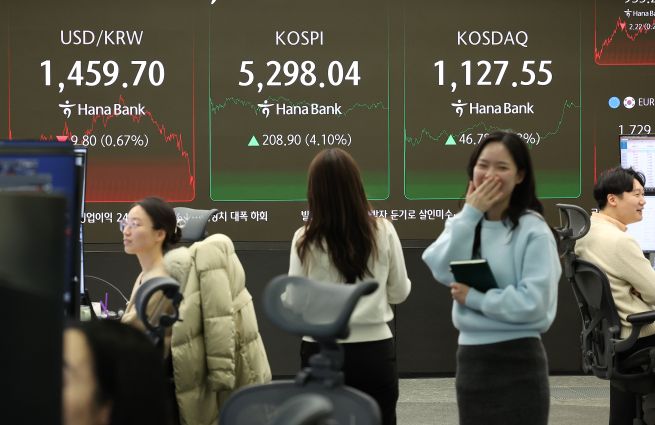
Employees monitor stock and currency movements at Hana Bank’s headquarters in Jung-gu, Seoul, on Feb. 9, after the Kospi rose more than 4 percent to close just below the 5,300 mark. (Image courtesy of Yonhap)
SEOUL, Feb. 10 (Korea Bizwire) — Younger South Koreans are increasingly turning to overseas markets, allocating far more of their portfolios to foreign exchange-traded products than to domestic shares, according to a new study that highlights a widening generational divide in investment behavior.
A report released Tuesday by the Korea Capital Market Institute found that individual investors held an average of 5.92 securities products per day, of which 4.91 were domestic stocks. But the composition shifts sharply by age.
Investors in their 20s held an average of 3.12 domestic stocks, compared with 5.41 among those in their 50s. Domestic shares accounted for 72.6 percent of total holdings among investors in their 20s, rising to 90.9 percent among those in their 60s — underscoring older investors’ preference for the local market.
Measured by asset value, the generational contrast is even starker. Among investors in their 20s, overseas exchange-traded products, including ETFs, made up 60 percent of total holdings — nearly double the 30.8 percent allocated to domestic stocks. Investors in their 30s allocated 45.5 percent of their portfolios to overseas ETPs.

Generation Gap Emerges in Investment Shift to Global Markets
By contrast, the overseas ETP share dropped steadily with age: 23.7 percent for those in their 40s, 16.7 percent for those in their 50s and 12.8 percent for those in their 60s. Domestic stocks accounted for a correspondingly larger share of portfolios in older cohorts, reaching 77 percent among investors in their 60s.
The study also found differences by gender. Women held a greater number of securities on average — 6.38 products compared with 5.52 for men — suggesting a more diversified approach. However, women showed a stronger preference for domestic markets, with local stocks accounting for 84.5 percent of their holdings, compared with 81.6 percent for men.
Men, meanwhile, allocated relatively higher shares to overseas stocks and ETPs. In terms of asset size, male investors also held larger portfolios on average, with holdings worth about 58.9 million won, roughly 30 percent more than the 44.1 million won held by women.
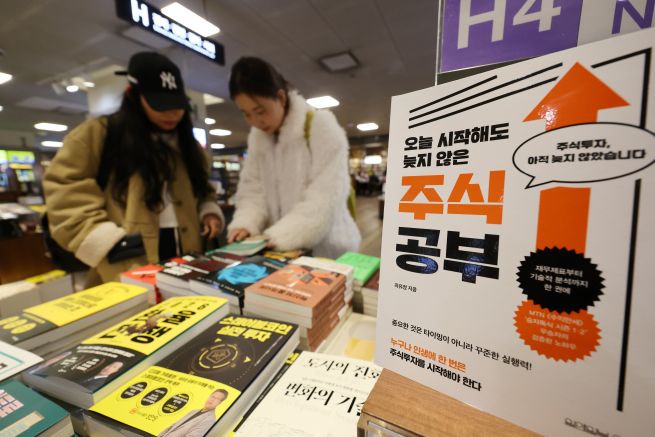
As the KOSPI has continued its steady climb toward the 5,000 mark since the start of the year, books related to financial investment have also been gaining popularity. The photo shows visitors browsing investment-related titles at the economics and stock investment section of the Kyobo Bookstore in Gwanghwamun, Jongno District, Seoul. (Yonhap)
Investment breadth also rose with wealth. Investors with less than 5 million won held an average of 2.7 products, while those with more than 300 million won held 12.9.
The share of domestic stocks declined as assets grew: from more than 80 percent among investors with under 100 million won to 69.7 percent for those above 300 million won. By value, domestic shares accounted for 62.3 percent of holdings among the smallest investors, compared with 43.4 percent for the wealthiest.
In performance terms, the report found that individual investors’ overall returns — across domestic and foreign assets — generally lagged broader stock market gains over the same period. While participation in overseas markets improved portfolio returns and risk-adjusted performance for some investors, roughly half still posted unsatisfactory results.
The authors called for expanded financial education tailored to young and small-scale investors, as well as stronger digital risk-warning systems. They also recommended promoting long-term, diversified investment accounts and enhancing tax incentives for long-term investing, while tightening oversight of high-risk products such as leveraged and inverse ETFs.
The findings suggest that while younger Koreans are embracing global markets with greater confidence, improved investor protection and education may be needed to ensure that enthusiasm translates into sustainable returns.
Ashley Song (ashley@koreabizwire.com)