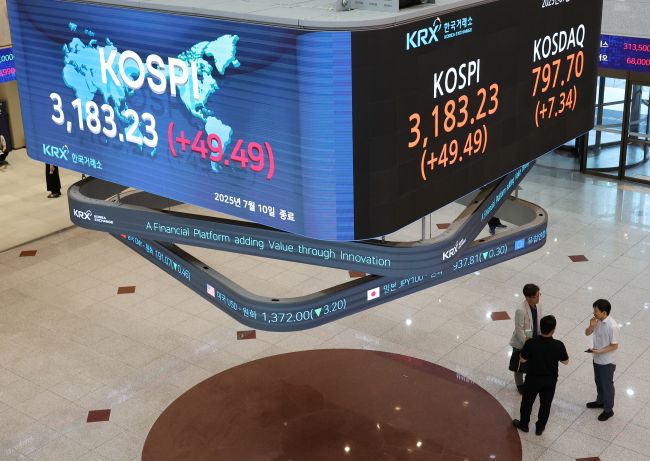
On July 10, the Korea Composite Stock Price Index (KOSPI) is displayed on an electronic board at the Korea Exchange in Yeouido, Seoul, following consecutive record highs. (Image courtesy of Yonhap)
SEOUL, July 16 (Korea Bizwire) — A new study has revealed that the trading strategies of South Korea’s National Pension Service (NPS), which oversees more than 1,000 trillion won ($730 billion) in assets, can significantly affect market volatility and transaction costs—particularly when investments are outsourced to external managers.
According to a report released Tuesday by the National Pension Research Institute, the pension giant’s domestically managed equity strategies show markedly different impacts on the stock market, depending on whether the fund is directly managed or contracted out, and whether it follows a passive or active investment model.
While about 30 percent of NPS’s domestic stock portfolio is managed through passive strategies, the majority—around 70 percent—is actively traded in pursuit of market-beating returns. Roughly half of these active investments are handled by external asset managers through so-called “delegated mandates.”
The study found that internal active strategies, particularly “core active” strategies run by the NPS itself, were more efficient in mitigating “market impact costs”—the hidden costs that arise when large-scale trades shift stock prices during execution. These internal strategies spread out trades and adjusted for market conditions to reduce disruptions.
In contrast, certain outsourced active strategies—especially pure equity mandates—were found to generate significantly higher market impact costs, exacerbating short-term volatility and reducing actual fund performance.
This effect was particularly pronounced on days when the pension fund was required to publicly disclose large shareholding changes, often triggered by crossing a 1% ownership threshold.
Moreover, the report observed that both foreign and retail investors tended to trade against NPS during its large transactions, employing contrarian strategies that aimed to profit from the pension fund’s perceived market influence. These reactive moves further contributed to short-term instability.
Given the NPS’s outsized presence in the Korean capital market, the findings underscore growing calls for more transparent and efficient fund management. The report recommended a revamp of performance evaluations and oversight systems for external managers and urged a strategic shift to strengthen the NPS’s internal investment capabilities to improve long-term returns and reduce market disruptions.
M. H. Lee (mhlee@koreabizwire.com)