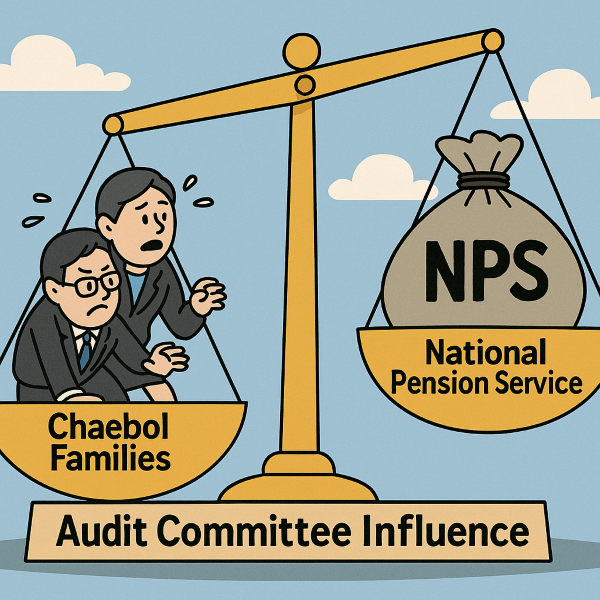
From Boardrooms to Ballots: Pension Fund Poised to Eclipse Chaebol Families in Audit Votes (Image supported by ChatGPT)
SEOUL, Aug. 19 (Korea Bizwire) — South Korea’s biggest conglomerates could see their founding families lose significant sway over board oversight if a second round of corporate law revisions clears the National Assembly, according to a new analysis.
Leaders Index, a corporate research firm, said Tuesday that under the proposed reforms, roughly 38 percent of the friendly stakes held by owner families across the top 50 business groups could lose voting rights when electing audit committee members.
The changes would build on the so-called “3 percent rule,” enacted earlier this year, which caps the combined voting rights of controlling shareholders and affiliates at 3 percent of total shares in audit committee elections.
The pending second-stage reform would go further by requiring cumulative voting for large listed firms with assets above 2 trillion won ($1.5 billion) and expanding the number of separately elected audit committee members from one to at least two.

A view of downtown Seoul with clusters of corporate buildings. (Yonhap)
If both reforms are applied, Leaders Index estimates that 37.8 percentage points of the average 40.8 percent “friendly stake” held by owners, affiliates, and affiliated foundations across 130 listed subsidiaries would be stripped of voting power.
The impact would be particularly acute for mid-sized steelmaker SeAH Group. Its affiliates and charitable foundations collectively control over 80 percent of SeAH Holdings, but nearly 78 percent of that influence could disappear under the proposed rules. Korea & Company Group and Lotte Group could also lose more than half of their effective voting rights.
In contrast, the National Pension Service (NPS) — Korea’s largest institutional investor — is expected to gain significant clout. The fund holds at least a 5 percent stake in 74 of the 130 companies analyzed, positioning it as a likely swing voter in future shareholder meetings.
While the reform package — dubbed the “tougher Commercial Act” — remains stalled amid partisan gridlock, observers expect it to advance under the Democratic Party’s leadership in coming weeks. If enacted, it would mark a sharp shift in Korea’s corporate governance, tilting power away from entrenched family owners toward institutional investors.
Ashley Song (ashley@koreabizwire.com)