
In 2020, the Ministry of Gender Equality and Family ran a voucher program to provide sanitary pads to low-income girls aged 11 to 18. The photo shows a Homeplus store designated as a participating retailer for the program.
SEOUL, Jan. 21 (Korea Bizwire) — President Lee Jae-myung on Tuesday signaled a push for stronger government intervention in everyday cost-of-living issues, calling for the development of low-cost sanitary pads — potentially distributed free of charge — while pressing ministers to accelerate reforms across welfare, labor safety and public integrity.
Speaking at a Cabinet meeting at the presidential office, Mr. Lee said South Korea’s sanitary products remain significantly more expensive than those sold overseas, estimating prices to be nearly 40 percent higher.
“Basic-quality sanitary pads should be made affordable,” he said, adding that the government should consider producing and supplying them directly to ensure access for low-income women. He instructed the minister of gender equality and family to examine options including government-commissioned manufacturing and free distribution to eligible groups.
Mr. Lee criticized reliance on subsidies alone, arguing that state support could unintentionally allow companies to inflate prices. “Consumers should have real choices,” he said.
The president also raised questions about the sustainability of the current basic pension system, under which benefits extend to roughly the bottom 70 percent of older adults. Citing rising fiscal costs, he asked whether it was appropriate for relatively higher-income seniors to receive uniform payments, and suggested a more targeted approach to address elderly poverty.
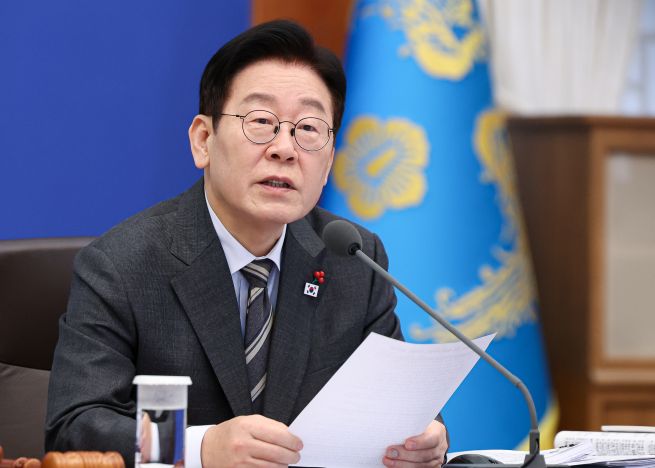
President Lee Jae-myung speaks during a Cabinet meeting at the presidential office on Jan. 20. (Photo courtesy of the Presidential Press Pool)
Throughout the meeting, Mr. Lee expressed frustration with delays in legislation affecting public welfare, urging ministers to press the National Assembly more aggressively. He singled out stalled bills related to industrial accident compensation and transparency in investigations of major workplace disasters.
When a labor minister joked about “asking lawmakers again,” Mr. Lee responded sharply, calling for stronger persuasion efforts to prevent livelihood-related legislation from becoming gridlocked.
The president also urged swift progress on regulatory reform bills, noting that many were not politically contentious and should not face prolonged delays — particularly with parliamentary committees chaired by members of the ruling Democratic Party.
Emphasizing public-sector discipline, Mr. Lee warned of corruption risks in ministries overseeing land, construction and infrastructure, ordering stricter personnel management and decisive action against misconduct.
He extended similar criticism to overseas diplomatic missions, citing repeated scandals involving harassment and abuse of local staff, and called for enhanced inspections and regular feedback from host communities.

Sanitary pad (Image courtesy of Getty Images Bank)
Mr. Lee also instructed ministries to consider mechanisms for reclaiming part of the economic value generated by government-issued permits and licenses, such as cable car concessions or bus route approvals, suggesting options including public equity stakes, time limits or public contribution requirements.
On energy policy, he urged a more structured public debate over the possible construction of new nuclear power plants, warning against ideological polarization and calling for broader consensus-building as concerns over electricity supply grow.
He also questioned proposals related to cultural symbolism, including plans to add a Korean-language sign alongside the Chinese-character plaque at Gwanghwamun Gate, asking ministers to carefully weigh historical context and opposing views.
Turning to the media, Mr. Lee criticized what he described as politically selective coverage of judicial rulings, arguing that licensed broadcasters and cable channels, which benefit from limited entry rights, carry heightened responsibilities for neutrality and public interest.
While reaffirming full protection for freedom of expression, he said public broadcasters must adhere to standards of fairness and balance.
The remarks offered a wide-ranging glimpse into the Democratic Party–led administration’s governing priorities, blending cost-of-living concerns with institutional reform and calls for greater accountability across government and media.
Lina Jang (linajang@koreabizwire.com)