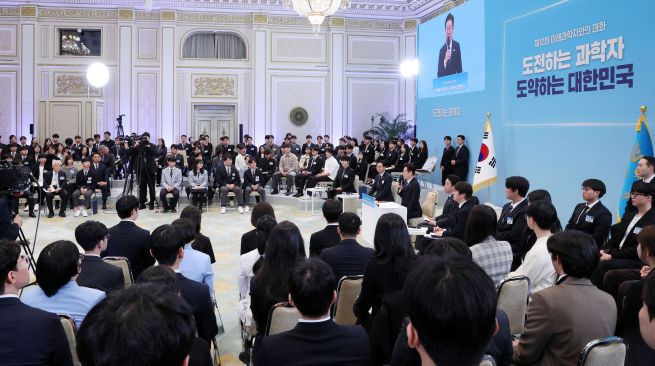
President Lee Jae Myung speaks at the event titled “Challenging Scientists, Advancing Korea,” held at the Blue House on Feb. 5. (Photo courtesy of the Blue House Press Corps)
SEOUL, Feb. 6 (Korea Bizwire) — President Lee Jae Myung on Thursday outlined an ambitious vision to overhaul South Korea’s military service system, suggesting a shift away from manpower-heavy conscription toward a structure centered on technology and specialized expertise.
Speaking at a forum with young scientists at the Blue House guest house, Mr. Lee said the current system — which requires most young men to serve nearly two years in uniform — can create unavoidable career gaps and social tensions, particularly for highly trained science and engineering talent.
He indicated that the government is reviewing an expansion of alternative service programs for researchers in advanced technology fields. “There is already alternative service in science and technology, but the question is whether it should be expanded,” Mr. Lee said, responding to a student’s question about allowing research experience during military duty.
Presidential officials confirmed that discussions are under way with the Military Manpower Administration and the Defense Ministry, whose leadership is said to be receptive. “We are considering expansion,” Mr. Lee added, signaling that policy deliberations have entered an active stage.
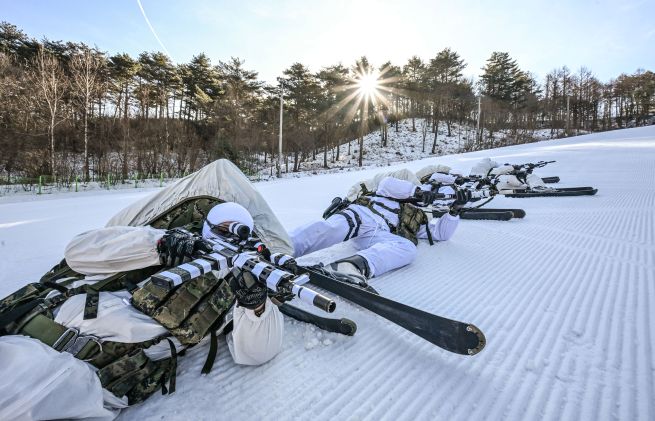
Soldiers from the Army Special Warfare Command take firing positions during a snowfield mobility exercise using tactical skis after encountering enemy forces. (Photo courtesy of the Army)
Going further, the president suggested a broader structural rethink of the armed forces. “We have moved from a troop- and infantry-centered military to one defined by competition in equipment and weapons systems,” he said. Rather than focusing on headcount, he argued, the military should cultivate specialists capable of mastering advanced technologies.
Mr. Lee floated the idea of integrating research functions within the armed forces, including the possible creation of dedicated research units where scientists could conduct experiments and operational development while in service.
The president also addressed broader talent policy concerns, calling the outflow of skilled workers overseas “a serious national issue” and pledging concrete measures to encourage their return. He emphasized reforms to the research and development system, including what he described as treating failed projects as assets rather than liabilities.
On regional development, Mr. Lee promised strong backing for cultivating talent outside the Seoul metropolitan area, telling a student from the Korea Institute of Energy Technology in Naju that creative and independent thinkers must be nurtured nationwide.
Whether the remarks translate into legislative or structural change remains uncertain. But by linking military reform, technological competitiveness and talent retention, Mr. Lee signaled that conscription — long a fixture of South Korean society — may be poised for its most significant reconsideration in decades.
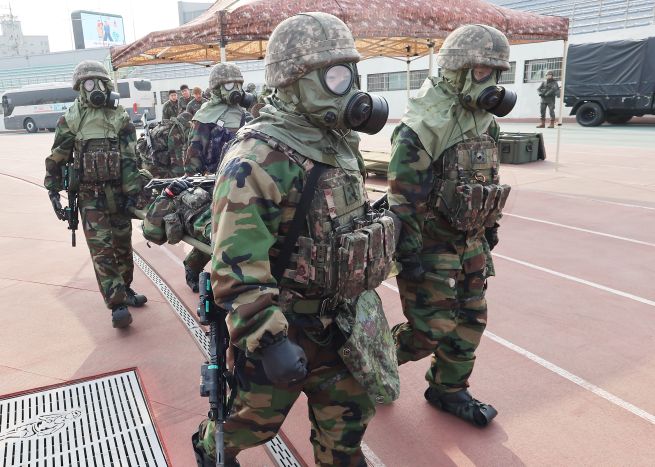
A “post-nuclear strike management exercise” is being conducted at Osan Sports Complex in Gyeonggi Province on Feb. 5. The drill was carried out under the scenario that a tactical nuclear weapon had been dropped on a nearby unit, resulting in damage. (Image courtesy of Yonhap)
M. H. Lee (mhlee@koreabizwire.com)