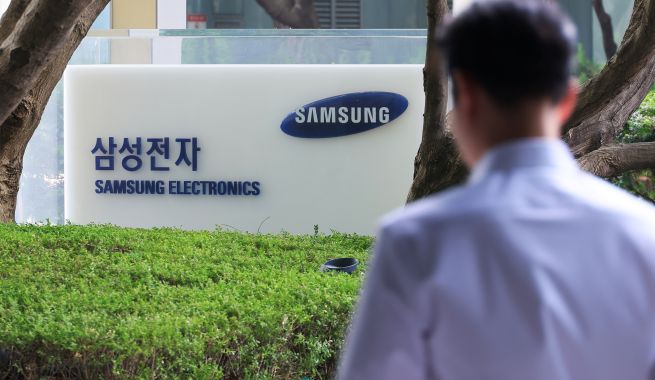
Samsung Electronics Co.’s corporate logo at its Seoul office (Yonhap)
SEOUL, July 28 (Korea Bizwire) — Samsung Electronics said Monday it has secured a landmark 22.8 trillion-won (approximately $16.4 billion) contract to supply artificial intelligence semiconductors, in what it described as the largest chip order in its history. The South Korean tech giant declined to name the customer in a regulatory filing, citing confidentiality. But hours later, Elon Musk publicly identified the buyer: Tesla.
The deal, which runs through the end of 2033, accounts for roughly 7.6 percent of Samsung’s annual revenue last year and marks a major milestone for its foundry business, long overshadowed by industry leader Taiwan Semiconductor Manufacturing Company (TSMC).
“Samsung’s giant new Texas fab will be dedicated to making Tesla’s next-generation AI6 chip,” Musk wrote on X, formerly Twitter, confirming that the AI chips will be produced at Samsung’s forthcoming semiconductor facility in Taylor, Texas. He added that the partnership is strategically “hard to overstate,” and hinted the agreement could eventually exceed the disclosed value.
The Texas fab, part of Samsung’s $37 billion U.S. investment initiative, is expected to begin operations in 2026, though it has reportedly faced delays amid challenges in securing anchor clients. The Tesla contract appears poised to reverse that trajectory.
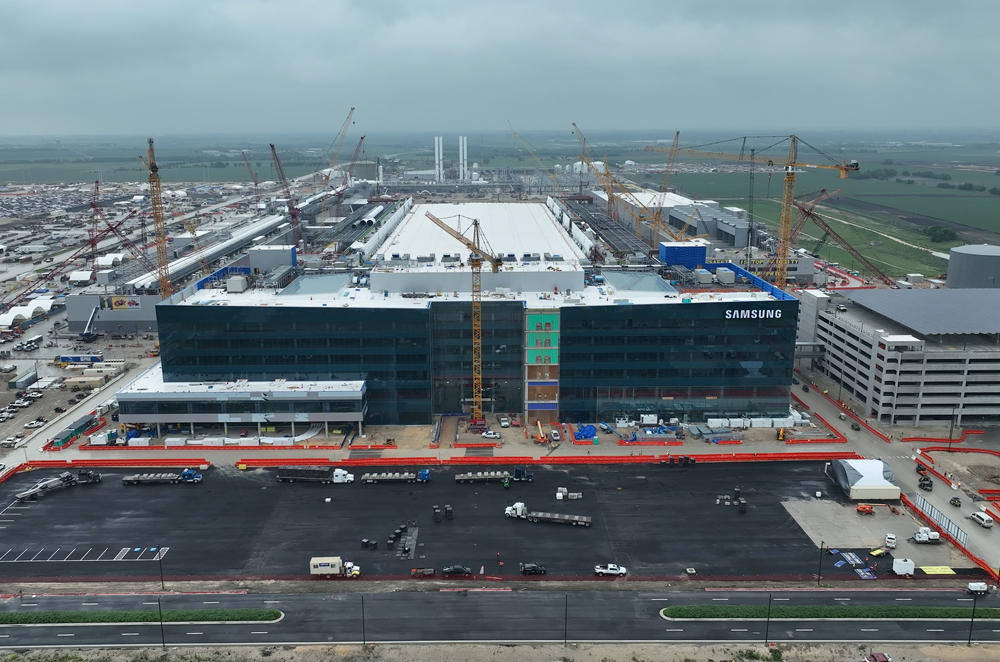
A view of Samsung Electronics’ semiconductor plant under construction in Taylor, Texas. (Image provided by Samsung Electronics)
Musk noted that Samsung is currently producing Tesla’s AI4 chips, while TSMC will manufacture the newly designed AI5 chips—initially in Taiwan, and later at its Arizona facility. The chips are critical to Tesla’s development of full self-driving (FSD) systems, which rely heavily on advanced AI processing.
“This is a critical point,” Musk added, indicating his personal involvement in accelerating the project’s progress. “And the fab is conveniently located not far from my house.”
The news comes at a pivotal time for Samsung’s foundry unit, which has struggled to gain ground against TSMC. In the first quarter of this year, Samsung held just 7.7 percent of the global foundry market, compared with TSMC’s dominant 67.7 percent, according to market tracker TrendForce.
Despite strong headline sales, Samsung’s foundry and system LSI divisions have weighed on the company’s recent earnings. Earlier this month, the firm forecast an operating profit of 4.59 trillion won on 74 trillion won in sales for the second quarter—figures that fell short of market expectations.
Still, the Tesla deal appears to have reinvigorated investor sentiment. Samsung Electronics shares surged 6.83 percent on Monday to close at 70,400 won, sharply outperforming the broader KOSPI’s 0.42 percent gain.
Kevin Lee (kevinlee@koreabizwire.com)