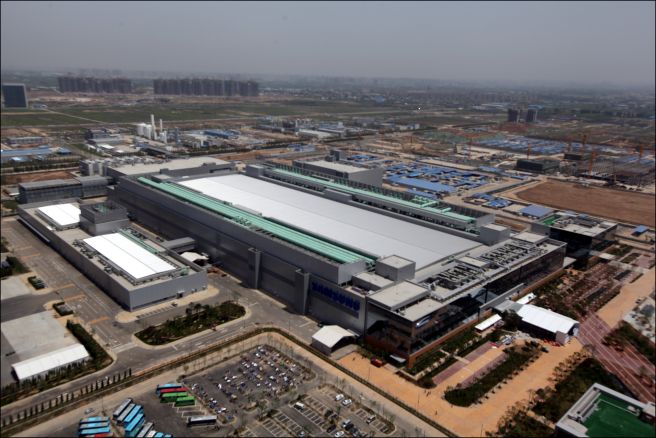
Samsung Electronics’ semiconductor plant in Xi’an, China (Yonhap)
SEOUL, Aug. 17 (Korea Bizwire) — Samsung Electronics reported a decline in first-half revenue from China, citing mounting U.S. sanctions, weakening demand, and intensifying local competition, while sales in the United States grew, buoyed by robust demand from Big Tech firms investing in AI infrastructure.
According to the company’s semiannual report released Sunday, Samsung’s exports to China fell to ₩28.79 trillion in the first half of 2025, an 11% drop from ₩32.35 trillion a year earlier. The decline reflects reduced momentum from Beijing’s “trade-in” subsidy program, sluggish economic recovery, and growing competition from Chinese chipmakers such as CXMT.
Although Samsung does not break down revenues by business unit in its regional reporting, most of its exports to China are believed to be semiconductor-related. These include mobile memory chips such as LPDDR and NAND, image sensors, display driver ICs, and high-bandwidth memory (HBM) chips like HBM2 and HBM2E.
Meanwhile, U.S. exports climbed to ₩33.48 trillion in the same period, surpassing China. This marks a reversal from late 2024, when Chinese sales temporarily outpaced the U.S. thanks to the Chinese government’s aggressive consumer stimulus campaign.
Samsung’s Chinese operations also showed signs of strain. The Xi’an-based NAND flash production unit, Samsung China Semiconductor (SCS), posted ₩4.41 trillion in sales and ₩533.6 billion in operating profit — both down from ₩6.02 trillion and ₩644.4 billion, respectively, a year earlier.
Sales at its Shanghai-based sales unit also declined to ₩12.35 trillion from ₩15.88 trillion, while operating profit slipped to ₩193.8 billion from ₩232.2 billion.
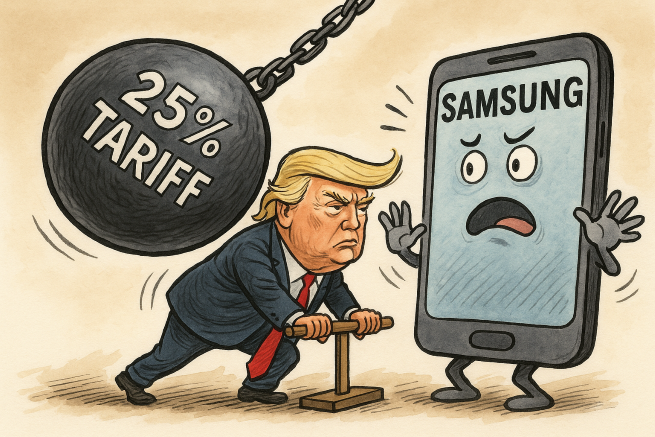
Samsung Faces Dilemma as Trump Threatens Tariffs on Foreign Smartphones (Image supported by ChatGPT)
Analysts attribute the downturn to a combination of diminishing policy boosts, delayed industrial recovery, and the tightening grip of U.S.-led semiconductor restrictions aimed at curbing China’s technological ascent.
By contrast, Samsung’s U.S. business is gaining momentum, thanks in part to soaring demand for AI chips and expanded foundry services. Its Texas-based foundry arm, Samsung Austin Semiconductor (SAS), recorded ₩2.3 trillion in revenue and ₩423.8 billion in operating profit — up 5.6% and 65.3% year-on-year, respectively.
The company’s U.S. semiconductor sales unit, Samsung Semiconductor Inc. (SSI), also logged impressive growth, with sales jumping 28.2% to ₩22.72 trillion, up from ₩17.73 trillion a year earlier.
The shift underscores Samsung’s increasing alignment with the U.S. tech ecosystem, as companies like Google, Amazon, and Microsoft ramp up AI server and data center investments — a trend that appears to be offsetting the company’s challenges in China.
Kevin Lee (kevinlee@koreabizwire.com)