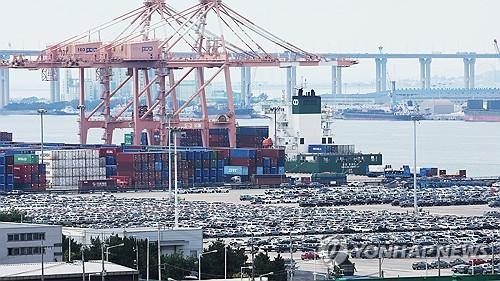
Containers are stacked at a port in the South Korean city of Pyeongtaek on July 31, 2025. (Yonhap)
SEOUL, Aug. 7 (Korea Bizwire) — South Korea recorded its largest-ever current account surplus in June, driven by rising exports of semiconductors and other key items, central bank data showed Thursday.
The country’s current account surplus reached US$14.27 billion in June, up from $10.14 billion the previous month, according to the data compiled by the Bank of Korea.
It marks the highest monthly surplus on record and the 26th consecutive month of surplus, as the country has maintained a current account surplus every month since May 2023.
During the first half of 2025, the cumulative current account surplus stood at $49.37 billion, compared with $40.16 billion recorded during the same period last year.
The goods account logged a $13.16 billion surplus in June, as exports advanced 2.3 percent from a year earlier to $60.37 billion on the back of strong sales of semiconductors, pharmaceuticals and computer peripherals, among other things.
Imports rose for the first time in three months, but the increase was a modest 0.7 percent, reaching $47.21 billion.
“There was some front-loaded demand ahead of the implementation of high U.S. tariffs. But demand for high-performance chips, such as DDR5 and high bandwidth memory (HBM), also remained solid,” BOK official Shin Seung-chul told a press briefing.
The services account, however, registered a $2.53 billion deficit for the month due mainly to rising demand for overseas travel and fewer inbound travelers.
The primary income account, which tracks the wages of foreign workers, dividend payments from overseas and interest income, logged a 4.16 million surplus in June, the data showed.
“Given that the customs-based trade balance posted the largest ever monthly surplus in July, the current account balance is expected to continue to log a substantial surplus,” Shin said.
“The U.S. tariff policy would negatively affect exports in the second half, but strong chip exports and dividend income are likely to help maintain a sound current account balance throughout the year,” he added.
Despite the U.S.’ planned item-specific tariffs on semiconductors and pharmaceuticals, South Korea is unlikely to lose competitiveness compared with its global peers, as the sectors receive most-favored-nation (MFN) treatment.
The auto industry may be affected by the new tariff scheme, though the extent of the impact will vary depending on corporate responses, such as export diversification, according to the official.
(Yonhap)