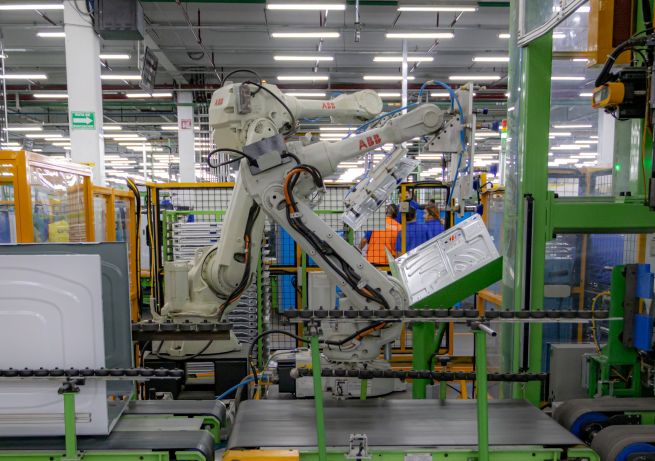
A scene of the Fourth Industrial Revolution where AI-powered home appliances are produced in collaboration with robots… Samsung’s Querétaro plant in Mexico (Image provided by Samsung Electronics)
SEOUL, Sept. 17 (Korea Bizwire) — South Korea is rolling out an ambitious blueprint to transform its manufacturing base with artificial intelligence, advanced semiconductors, and clean energy infrastructure, part of President Lee Jae-myung’s drive to position the country among the world’s top four manufacturing powers by the end of the decade.
The Ministry of Trade, Industry and Energy said Monday it will spearhead seven of the administration’s 123 national policy priorities, with measures ranging from AI-powered “factories of the future” to the rapid expansion of renewable energy grids.
Officials set bold targets: by 2030, they aim to raise industrial AI adoption to 70 percent, expand bio-health exports by more than 35 percent, localize 70 percent of core components for drones and urban air mobility vehicles, and lift defense exports through breakthroughs in advanced materials and equipment.
Semiconductors remain at the center of the plan. The government pledged to support development of AI-embedded chips and next-generation high-bandwidth memory, with a goal of boosting chip exports to $170 billion by 2030. Automakers are expected to accelerate the shift toward electric, software-defined, and autonomous vehicles, while battery makers target a 25 percent global market share.
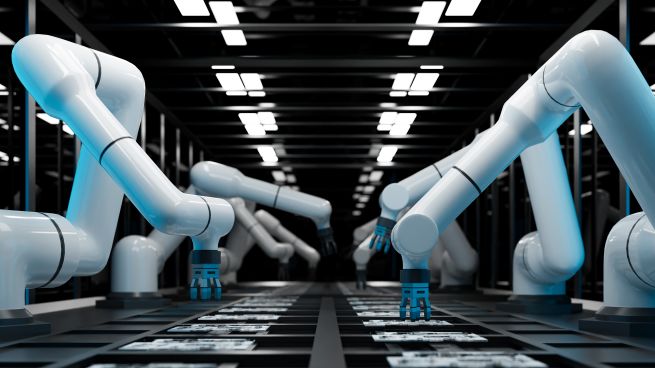
Seoul Maps Out Industrial Reinvention to Join World’s Top Four Manufacturing Powers (Yonhap)
Infrastructure expansion is equally central. Seoul intends to accelerate construction of a “West Coast energy highway,” linking industrial hubs with renewable sources, and complete a U-shaped national power grid by the 2040s. The government will enlist private builders through turnkey contracts to speed up grid deployment, and overhaul management systems to ensure stability and efficiency.
The initiative also places heavy emphasis on carbon neutrality. Officials pledged to revise strategies to meet South Korea’s 2035 emissions reduction goal, bolster defenses against overseas carbon border tariffs, and turn Saemangeum into a renewable energy hub with solar and wind projects designed to power export-driven industries.
Trade policy will be aligned with these industrial shifts, with the government framing its agenda as preparation for a “$1 trillion export era.”
“The ministry will mobilize every resource to ensure Koreans can see tangible results in their daily lives and in industry,” the Trade Ministry said in a statement.
The sweeping agenda underscores Seoul’s effort to balance its reliance on semiconductors with broader industrial diversification, while building a greener foundation for long-term growth in an era of intensifying global competition.
M. H. Lee (mhlee@koreabizwire.com)