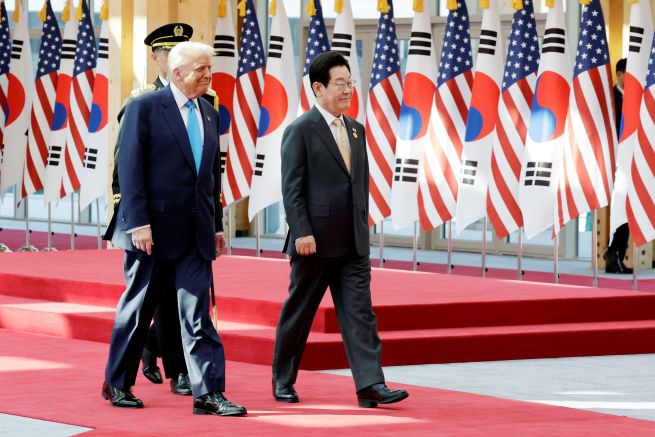
President Lee Jae Myung and U.S. President Donald Trump review an honor guard during an official welcome ceremony at the Gyeongju National Museum in North Gyeongsang Province on October 29. (Pool photo) (Yonhap)
GYEONGJU, South Korea, Oct. 29 (Korea Bizwire) – South Korean President Lee Jae Myung used a high-stakes summit in Gyeongju on Wednesday to push Washington toward a long-sought goal: the fuel needed to operate nuclear-powered submarines.
Meeting U.S. President Donald Trump in the ancient capital, Lee argued that South Korea’s diesel-powered fleet no longer provides the stealth or range needed to track increasingly active North Korean and Chinese submarines.
His request, he stressed, has nothing to do with arming the vessels with nuclear weapons. Instead, he said, access to enriched uranium would allow Seoul to build conventionally armed submarines that could better secure the waters around the peninsula and ease the burden on the United States military.
The conversation reflects a broader tension in the decades-old nuclear partnership between Seoul and Washington. Under current terms, South Korea must secure U.S. consent for any uranium enrichment above low levels, and it is barred from reprocessing spent reactor fuel entirely. Lee wants that changed.
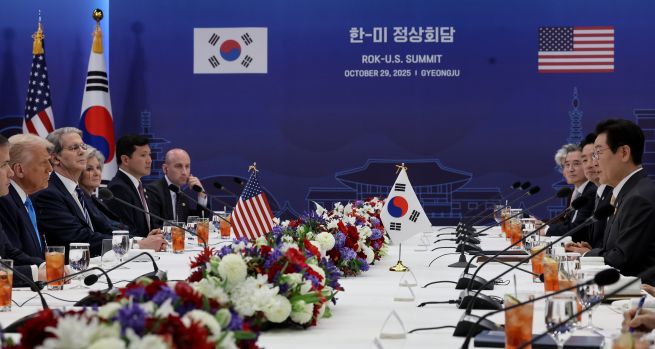
President Lee Jae Myung (R) holds a summit with U.S. President Donald Trump (L) at the Gyeongju National Museum in the southeastern city of Gyeongju on Oct. 29, 2025. (Pool photo) (Yonhap)
He asked Trump to direct his administration to accelerate negotiations on revising the bilateral nuclear agreement, seeking more room for autonomy in a technology that shapes both security and sovereignty.
Lee also portrayed these defense ambitions as part of a wider push to “modernize” the alliance. His government plans to raise military spending and invest more aggressively in the domestic defense industry, a message clearly calibrated to appeal to Trump: South Korea, he suggested, intends to shoulder more of its own security.
Economic diplomacy was never far from the surface. Lee reiterated his support for Trump’s efforts to revive U.S. manufacturing, pointing to Seoul’s proposed Make American Shipbuilding Great Again (MASGA) initiative and a broad US$350 billion investment pledge as evidence that the alliance can be both strategic and transactional.
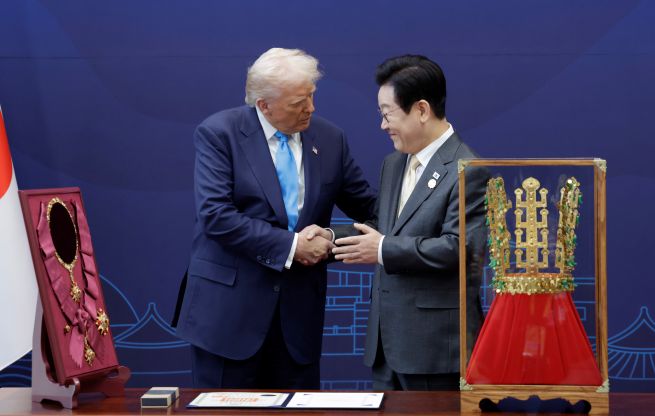
President Lee Jae Myung (R) awards U.S. President Donald Trump with the “Grand Order of Mugunghwa,” South Korea’s highest order, at the Gyeongju National Museum in the southeastern city of Gyeongju on Oct. 29, 2025, making him the first U.S. president to receive it. (Pool photo) (Yonhap)
Cooperation in shipbuilding, he said, would generate jobs in the United States while keeping the partnership grounded in shared industrial interests.
The Gyeongju summit, the second since the leaders met in Washington in August, had been closely watched for signs that the two sides might settle thorny trade differences, including U.S. tariffs.
Neither leader touched the issue in their opening remarks. Trump, however, told business leaders at the APEC CEO Summit earlier in the day that a deal would be reached “very soon,” a claim officials on both sides greeted with caution.
Another piece of diplomatic theater did not materialize: a meeting between Trump and North Korean leader Kim Jong-un. Trump said the timing could not be arranged. Lee offered a more pointed interpretation, citing what he described as Kim’s lack of “sincerity” in negotiations.
Still, he insisted that Trump’s continued openness to dialogue has created “a sense of warmth and peace” on the peninsula, a small but vital signal in a region where hopes for diplomacy tend to be fragile.
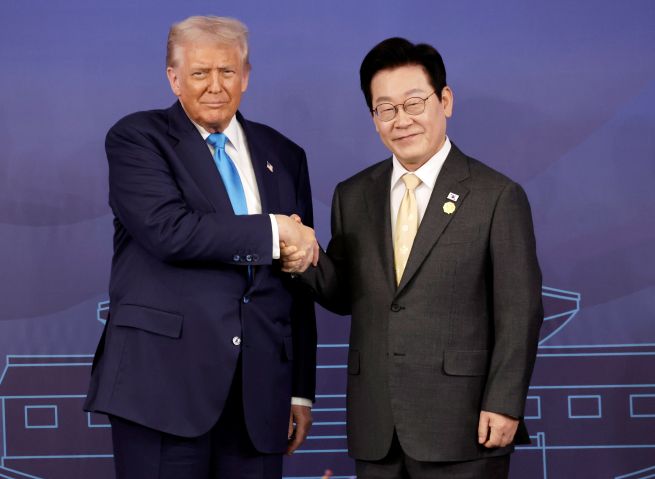
President Lee Jae Myung (R) shakes hands with U.S. President Donald Trump during their summit at the Gyeongju National Museum in the southeastern city of Gyeongju on Oct. 29, 2025. (Pool photo) (Yonhap)
M. H. Lee (mhlee@koreabizwire.com)