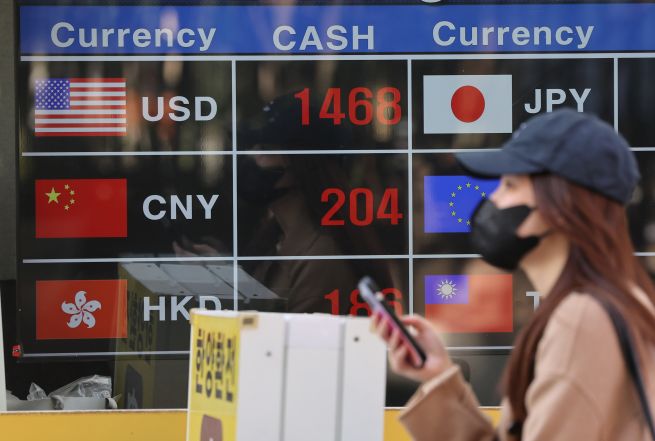
Leaders of South Korea’s financial and monetary authorities have expressed concern over rising uncertainty in the foreign exchange market and said they will actively use all available tools. The photo shows a currency exchange shop in Myeong-dong, central Seoul, on November 14. (Yonhap)
SEOUL, Nov. 26 (Korea Bizwire) — Finance Minister Koo Yun-cheol said Wednesday that South Korea stands ready to take “decisive action” to curb excessive volatility in the foreign-exchange market, as the won continues to face downward pressure against the U.S. dollar.
“The won tends to react more sensitively than other currencies,” Koo told reporters, adding that authorities are watching for speculative flows and “one-sided” market moves. “We will act decisively if volatility expands excessively.”
The comments come as the government, the Bank of Korea, the National Pension Service and the Ministry of Health and Welfare have formed a new four-way consultative body aimed at easing strain on the currency while safeguarding pension-fund performance. The group held its first meeting Monday.
Koo emphasized that the framework is not an attempt to enlist the NPS as a tool to counter the won’s slide. Instead, he said, the goal is to develop longer-term measures that stabilize pension payouts without undermining returns for the world’s third-largest pension fund.
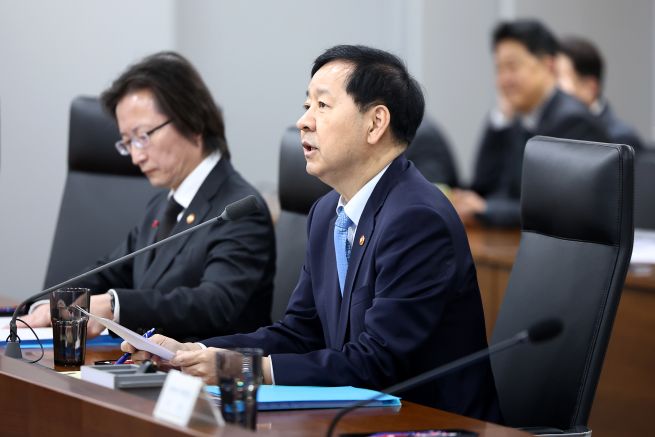
Finance Minister Koo Yun-cheol (R) speaks during a meeting of economy-related ministers at the Sejong Government Complex in central South Korea on Nov. 26, 2025. (Yonhap)
Still, the NPS’ rapid expansion abroad has become a market factor. The fund’s assets now exceed half of South Korea’s real GDP, and its growing overseas allocation has been cited by traders as adding pressure to the won.
“As the NPS expands its overseas investments, its impact on the FX market inevitably increases,” Koo said. He added that heavy short-term investment abroad can weaken purchasing power, lift inflation and erode real income — risks policymakers must weigh against the fund’s profitability mandate.
Analysts say discussions could include a push for more active hedging by the NPS, including selling a portion of its dollar assets if the won’s depreciation becomes disorderly.
Asked about potential concerns from Washington, Koo said U.S. officials “also appear to want stability” in Korea’s FX market. The Treasury Department has kept South Korea on its monitoring list for currency practices since late 2024, citing the NPS’ expanding foreign assets and the $65 billion swap line with the Bank of Korea as factors it is watching.
Koo also said incentive measures to encourage exporters to convert dollar holdings into won could be considered “at any time” if needed.
After touching its weakest level since April, the won strengthened for a second straight session on Wednesday.
M. H. Lee (mhlee@koreabizwire.com)