

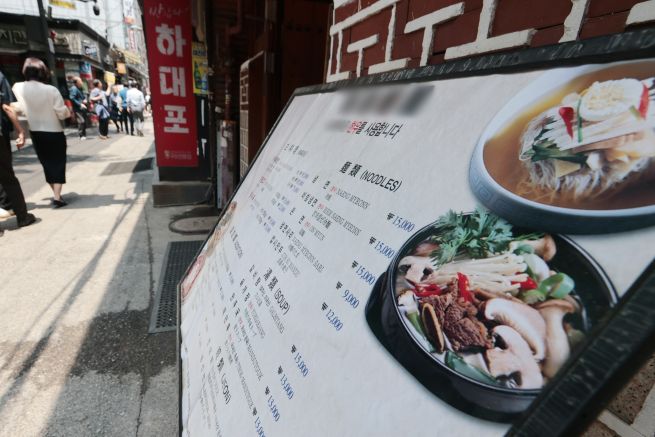
According to the Korea Consumer Agency’s price information portal “Price Information” on June 17, the average price of a bowl of naengmyeon (cold noodles) in Seoul rose from 12,115 won in April to 12,269 won last month, an increase of 154 won. The price of samgyetang, a popular summer health food, has also gone up. The photo shows the menu of a naengmyeon restaurant in Seoul on the same day. (Yonhap)
SEOUL, June 18 (Korea Bizwire) — The Bank of Korea has raised alarm over South Korea’s persistently high cost of essential goods, warning that it is outpacing both inflation and global averages, and is stifling consumer spending—particularly among low-income households.
In a report released Wednesday, the central bank found that from the onset of the COVID-19 pandemic in 2021 through May 2025, the cumulative increase in prices of essential living goods—food, clothing, and housing—rose 19.1%, significantly higher than the overall consumer price index growth of 15.9% over the same period.
The surge, the report explains, stems from pandemic-era supply chain disruptions, the ongoing Russia-Ukraine war, and extreme weather events. More recently, the depreciation of the Korean won and rising costs of imported raw materials have driven up the prices of processed foods.
Compared to other major economies, Korea’s essential goods are now notably more expensive. Using the OECD average price level as a benchmark of 100, South Korea’s food, apparel, and housing costs stand at 156, 161, and 123 respectively.
A separate 2023 survey by the Economist Intelligence Unit also found that Korean prices for fruits, vegetables, and meat were more than 1.5 times the OECD average.
This cost burden, the Bank of Korea warned, is disproportionately impacting economically vulnerable groups, dampening purchasing power and weakening overall consumer recovery. Real household purchasing power between 2021 and Q1 2025 grew by just 2.2% annually on average—well below the pre-pandemic rate of 3.4%.
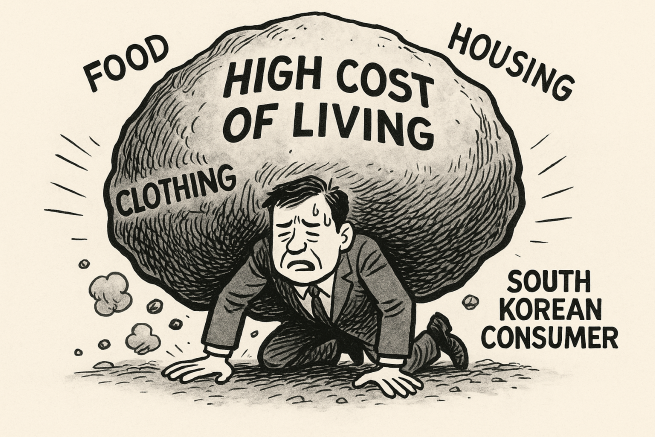
High Living Costs Undermine South Korea’s Consumer Spending, Central Bank Warns (Image supported by ChatGPT)
According to the central bank’s own surveys, 62% of respondents who did not increase spending in the first four months of this year cited rising prices and reduced purchasing power as the primary reason.
“If households continue to feel the sting of high living costs, it could entrench elevated inflation expectations and threaten long-term price stability,” the report cautioned.
The Bank of Korea urged structural reforms to enhance market competition by reducing regulations and lowering entry barriers. It also called for the diversification of raw material import sources to mitigate the ripple effects of supply shocks across product categories.
In the short term, it recommended deploying tariff relief measures—such as quota tariffs—to stabilize prices of imported agricultural inputs.
A second report issued the same day highlighted that processed foods and personal services contributed 1.4 percentage points to the overall consumer price rise in May, accounting for nearly 75% of the inflation uptick.
The central bank attributed this pressure to rising input costs driven by higher prices for imported intermediate goods and the weakening won since 2020. It also noted that while these costs tend to be swiftly passed on to consumers in the form of higher prices, any subsequent declines in input costs rarely translate into lower prices at the consumer level.
“There’s an asymmetry,” the report stated. “Even when input costs fall, producers are often reluctant to lower their prices, indicating limited elasticity in consumer price adjustments.”
This analysis comes as the administration of President Lee Jae-myung faces mounting pressure to rein in living costs. Meanwhile, renewed global trade tensions under the re-elected Trump administration in the United States are adding further complexity to Korea’s economic outlook.
Ashley Song (ashley@koreabizwire.com)





Pingback: Debunking right wing myths – Reform’s racist grift will only ever benefit the rich | daryanblog
Pingback: Debunking right wing myths – Reform’s racist grift will only ever benefit the rich | daryanenergyblog