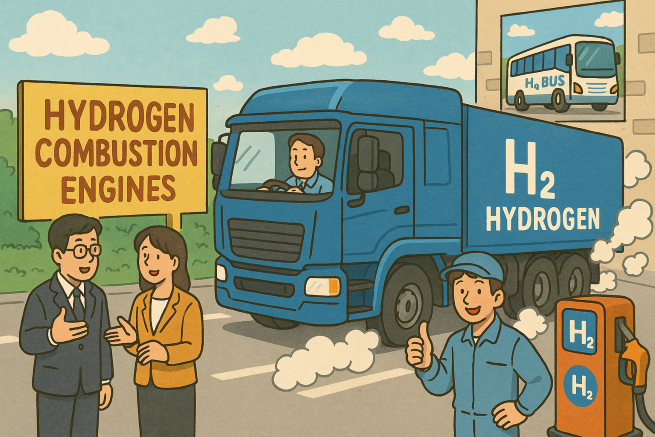
South Korea Explores Hydrogen Combustion Engines for Commercial Vehicles (Image supported by ChatGPT)
SEOUL, May 30 (Korea Bizwire) — South Korea is exploring the commercial potential of hydrogen combustion engines as an alternative path to decarbonizing heavy-duty vehicles, the Ministry of Environment announced Thursday.
The ministry will host a policy forum on May 30 at Seoul’s Ferrum Tower to discuss strategies for expanding hydrogen-powered transportation. The event, organized by the Korea Natural Gas and Hydrogen Vehicle Association, is expected to draw over 120 experts and industry stakeholders.
Insights from the forum will inform the government’s review of introducing hydrogen combustion engines into the commercial vehicle market.
Unlike hydrogen fuel cell vehicles — which generate electricity through a chemical reaction between hydrogen and oxygen — hydrogen combustion engines function similarly to diesel engines, burning hydrogen to generate mechanical power.
While fuel cell vehicles offer higher energy efficiency (40–60%) and zero emissions aside from water vapor, hydrogen combustion engines deliver slightly lower efficiency (25–35%) and emit nitrogen oxides (NOx), though they produce no carbon emissions.
Despite these drawbacks, hydrogen combustion engines present practical advantages. Their architecture closely resembles existing diesel and gas engines, enabling cost-effective retrofitting without the need to redesign entire vehicle platforms.
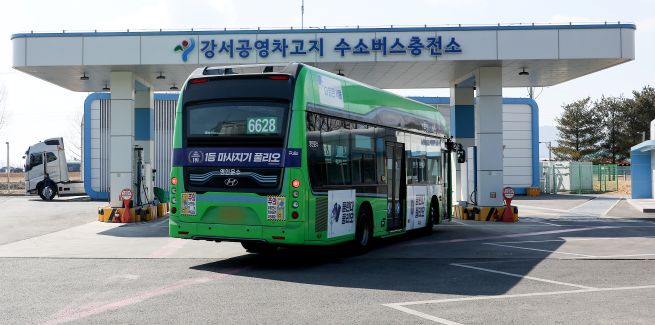
A hydrogen bus pulls into a charging station in Seoul. (Yonhap)
They can also utilize lower-purity hydrogen, recharge more quickly, and avoid the weight and cost penalties associated with large batteries.
HD Hyundai Infracore has been leading domestic efforts to develop this technology since 2021. Its first hydrogen engine, the HX12 — unveiled in April 2024 — is based on a CNG bus engine and achieves up to 43% efficiency.
The forum will also highlight progress in South Korea’s hydrogen fuel cell bus rollout. In 2024 alone, 1,044 units were deployed, bringing the total fleet to 1,982 — a 1.6-fold increase over the previous five years combined.
Between January and April 2025, an additional 287 buses were delivered. The number of hydrogen charging stations for commercial vehicles reached 152 as of April, up from 139 in 2024.
The ministry’s initiative underscores South Korea’s commitment to diversifying its clean transport technologies while balancing scalability and infrastructure feasibility.
M. H. Lee (mhlee@koreabizwire.com)