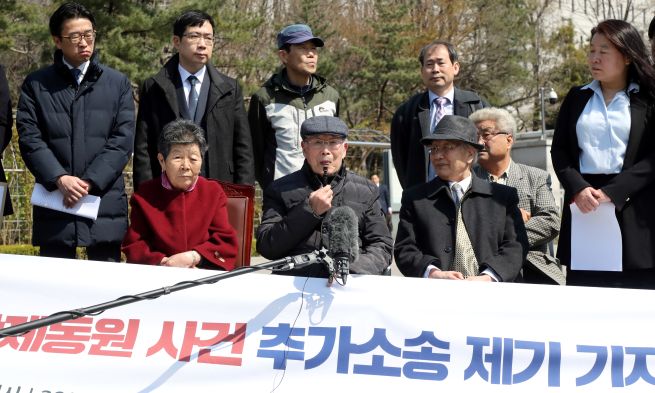
Kim Han-soo (C), a South Korean victim of Japan’s wartime forced labor, speaks during a press conference in southern Seoul, in this file photo taken April 4, 2018, over damages suits seeking compensation from Japanese companies. (Yonhap)
SEOUL, June 8 (Korea Bizwire) — A South Korean appeals court has ruled in favor of a 107-year-old victim of Japan’s wartime forced labor, ordering Mitsubishi Heavy Industries to pay compensation nearly 80 years after the abuse occurred.
The civil appeals division of the Seoul Central District Court overturned a 2022 lower court decision that had dismissed the claim filed by Kim Han-soo, citing the expiration of the statute of limitations. In a ruling issued in May 2025, the court ordered Mitsubishi to pay Kim 100 million won (approximately US$73,400) in damages.
Kim was conscripted in 1944 to work in a shipyard operated by Mitsubishi during Japan’s colonial rule of Korea (1910–1945). Despite the ruling, Mitsubishi is not expected to comply with the compensation order, continuing a longstanding standoff over such cases.
Previous lawsuits brought by South Korean victims of forced labor had largely been dismissed due to the statute of limitations, which under Korean civil law generally expires three years after the victim becomes aware of the harm and the responsible party. Many courts had marked this expiration at May 2015, following a 2012 Supreme Court ruling that first recognized the victims’ right to claim damages.
However, the appeals court in Kim’s case took a different view, determining that the limitation period should instead be calculated from a subsequent 2018 Supreme Court decision, which again affirmed the liability of Japanese companies. Kim’s lawsuit, filed in 2019, was therefore deemed timely.
The 2018 ruling had reignited diplomatic tensions, with Japan maintaining that all wartime compensation claims were settled under the 1965 treaty normalizing relations between the two countries. South Korean courts, however, have increasingly ruled in favor of victims, asserting that individual rights to reparation were not nullified by the treaty.
The decision in Kim’s case adds renewed pressure to the unresolved legacy of Japan’s colonial-era forced labor — and highlights the continuing legal and diplomatic complexities surrounding historical justice in East Asia.
M. H. Lee (mhlee@koreabizwire.com)