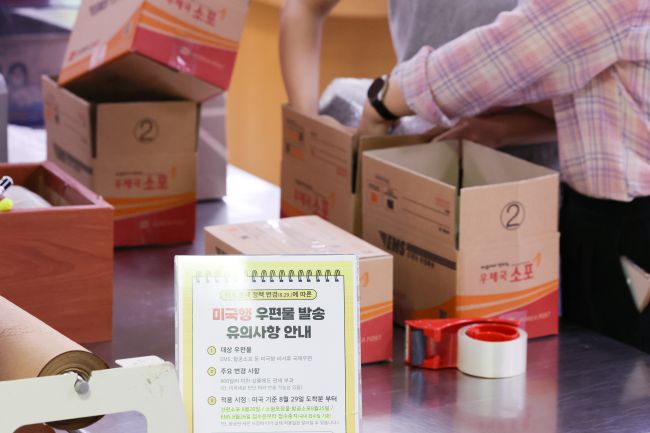
On the 25th, at the Gwanghwamun Post Office in Jongno-gu, Seoul, a notice was posted regarding the phased suspension of international mail services to the United States due to changes in U.S. customs policy. (Image courtesy of Yonhap)
SEOUL, Sept. 3 (Korea Bizwire) — Korean e-commerce platforms are bracing for shifting consumer behavior after the United States scrapped its longstanding tax exemption on small imports, a move that effectively raises prices for American shoppers buying Korean products.
Since Aug. 29, parcels valued under $800 — previously exempt from import duties — have been subject to a 15 percent tariff. Retailers including Musinsa Global, CJ Olive Young and Kurly have begun incorporating the duty directly into checkout prices rather than billing consumers on delivery, in an effort to ease confusion and maintain transparency.
Musinsa has warned customers of possible shipping delays as U.S. customs tightens inspections, while Kurly, which recently launched a service promising 48-hour nationwide delivery in the United States, said it is monitoring clearance procedures closely. Gmarket’s global shop, meanwhile, said it remains largely unaffected as its cross-border business is focused on Hong Kong, Taiwan and Macau.
The policy change could temper demand for K-beauty and other popular Korean exports. Although South Korea’s cross-border online sales rose 7.5 percent year-on-year in the second quarter to 738.8 billion won ($548 million), industry officials caution that higher prices may erode competitiveness. The United States accounts for roughly one-fifth of Korea’s direct online exports, behind China and Japan.
Retailers say they plan to counter the burden with targeted promotions and discounts, but acknowledge that the long-term impact of the U.S. tariff shift on Korea’s booming reverse direct-purchase market remains uncertain.
Ashley Song (ashley@koreabizwire.com)