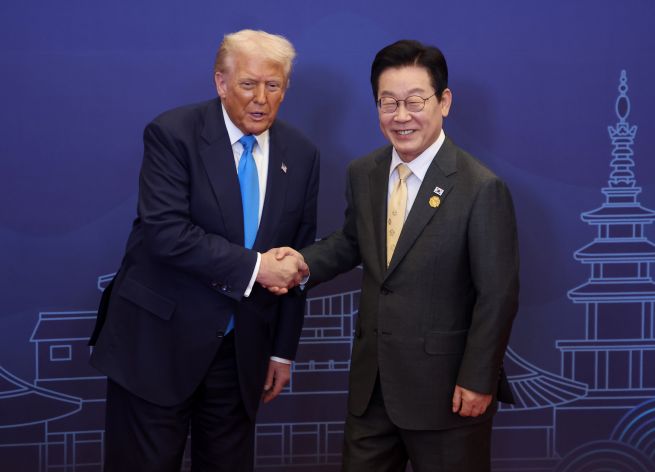
President Lee Jae Myung greets U.S. President Donald Trump ahead of a presidential state dinner held in the Grand Ballroom of the Hilton Hotel in Gyeongju, North Gyeongsang Province, on October 29. (Yonhap)
WASHINGTON, Nov. 13 (Korea Bizwire) – The United States has formally endorsed South Korea’s long-standing ambition to build nuclear-powered submarines and expressed support for Seoul’s push to acquire civil uranium enrichment and spent-fuel reprocessing capabilities, according to a joint fact sheet released Thursday.
The document, issued by the White House, summarizes the outcomes of two recent summits between President Lee Jae-myung and U.S. President Donald Trump — one held in Washington in August, and another in the southeastern city of Gyeongju last month ahead of the Asia-Pacific Economic Cooperation summit.
It is the first high-level bilateral statement released since the Lee administration took office in June and outlines a wide-ranging set of security and trade agreements, including Seoul’s pledge to invest US$350 billion in the United States in exchange for a reduction of “reciprocal” tariffs on Korean imports to 15 percent from 25 percent.
“Consistent with the bilateral 123 agreement and subject to U.S. legal requirements, the United States supports the process that will lead to the ROK’s civil uranium enrichment and spent-fuel reprocessing for peaceful uses,” the statement reads, using the acronym for the Republic of Korea. It adds: “The United States has given approval for the ROK to build nuclear-powered attack submarines.”
Under the current 123 agreement — the bilateral civil nuclear pact — South Korea is barred from enriching uranium or reprocessing spent fuel, a restriction Seoul has long sought to ease as it grapples with energy-security concerns and growing nuclear-waste stockpiles. Securing these capabilities is also widely viewed as a prerequisite for operating nuclear-powered submarines, a strategic asset coveted by Seoul as it confronts North Korea’s expanding nuclear arsenal.
Washington’s endorsement marks a significant milestone in South Korea’s decades-long effort to obtain the vessels and comes as the Trump administration urges allies in the Indo-Pacific to bolster their own defenses amid intensifying competition with China.
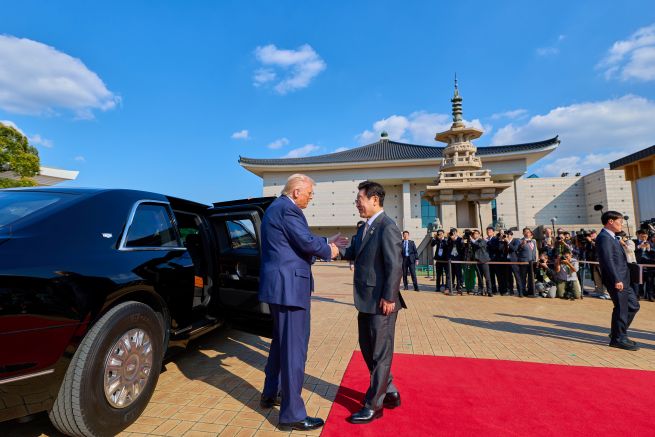
President Lee Jae Myung welcomes U.S. President Donald Trump upon his arrival at the Gyeongju National Museum, the venue of the South Korea–U.S. summit, on October 29. (Photo courtesy of the presidential office)
Trade Commitments and Tariff Adjustments
The fact sheet says the United States will lower tariffs on automobiles, auto parts, timber and other goods to 15 percent. It does not specify when the revised auto tariffs will take effect.
On pharmaceuticals, Washington intends to cap tariffs on Korean products at 15 percent. It also pledges to offer Seoul tariff terms on semiconductors “no less favorable” than any deal extended to other major chip suppliers in a future trade agreement.
The document affirms Seoul’s plan to invest $150 billion in the U.S. shipbuilding sector and an additional $200 billion under a forthcoming “Memorandum of Understanding with respect to Strategic Investments.” It also notes provisions designed to address South Korea’s concerns about foreign-exchange volatility, stating that Seoul will not be required to supply more than $20 billion in U.S. dollars in any calendar year.
Defense Commitments and Alliance Posture
On security, the United States reaffirmed its commitment to the “enduring” presence of U.S. Forces Korea — a point closely watched in Seoul amid periodic speculation about possible troop reductions. Washington also reiterated its extended-deterrence pledge, including the use of nuclear capabilities, and both presidents agreed to deepen cooperation through consultation bodies such as the Nuclear Consultative Group.
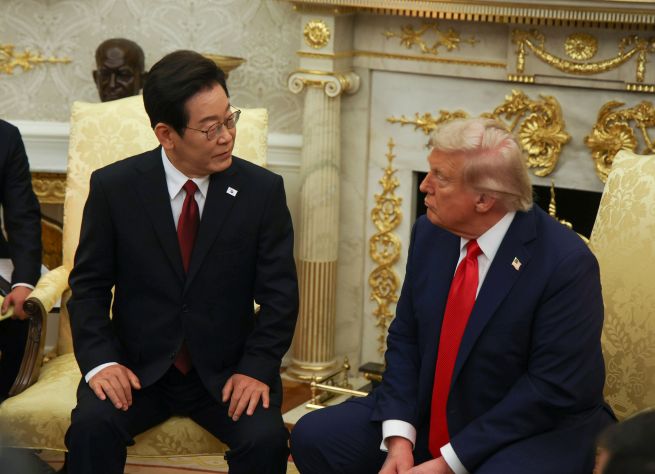
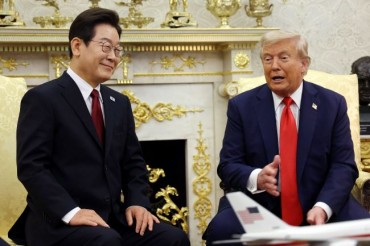
President Lee Jae Myung (L) holds summit talks with U.S. President Donald Trump at the Oval Office in the White House in Washington on Aug. 25, 2025. (Yonhap)
The document highlights Seoul’s pledge to raise defense spending to 3.5 percent of GDP “as soon as possible,” in keeping with domestic legal procedures. South Korea will spend $25 billion on U.S. weapons purchases by 2030 and provide $33 billion in support for U.S. Forces Korea, the fact sheet says.
The two leaders also vowed to continue preparing for the transition of wartime operational control (OPCON) — which the Lee administration aims to complete before its term ends in 2030. South Korea ceded wartime command of its forces to the U.N. Command during the 1950–53 Korean War; the authority now rests with the U.S.–ROK Combined Forces Command, though Seoul regained peacetime control in 1994.
In a nod to broader regional tensions, the document notes that the allies will strengthen U.S. conventional deterrence against “all regional threats,” including North Korea. It also reaffirms “relevant understandings since 2006,” a reference to the longstanding U.S. concept of “strategic flexibility” — allowing American forces stationed on the peninsula to respond to contingencies beyond Korea, including potential conflicts involving China. Seoul, for its part, reiterated its position that it would not be drawn into such a conflict without public consent.
M. H. Lee (mhlee@koreabizwire.com)