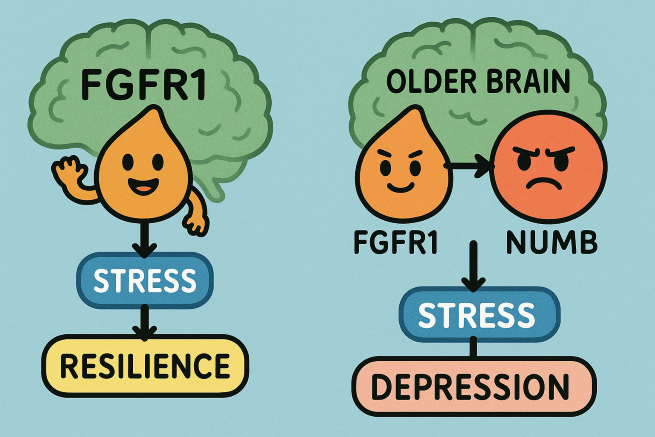
South Korean Scientists Map a New Pathway in Depression, Opening Door to Age-Specific Therapies (Image supported by ChatGPT)
DAEJEON, Aug. 19 (Korea Bizwire) — A team of South Korean scientists has identified a previously unknown molecular pathway that may help explain why depression develops — and why standard treatments often fail in older patients.
KAIST announced Tuesday that its researchers, working with the National Forensic Service and Ajou University Hospital, discovered that heightened activity of the FGFR1 gene in the hippocampus plays a crucial role in regulating stress resilience and depressive symptoms. The findings were published August 15 in the international journal Experimental & Molecular Medicine.
The team analyzed brain tissue from patients who had died by suicide and from mouse models of depression. They found that when stress was induced, the hippocampal dentate gyrus — a region critical for forming new memories — showed markedly increased expression of FGFR1, a receptor linked to cell growth and differentiation.
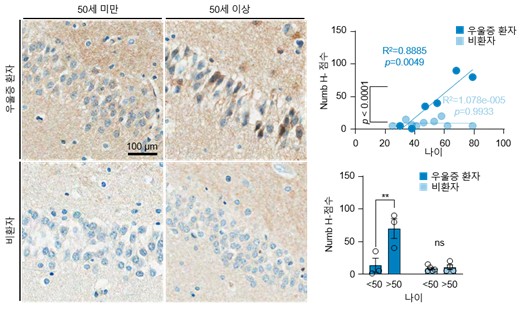
Comparison of postmortem brain tissue in depression patients by age (Image provided by KAIST)
Mice engineered without the FGFR1 gene exhibited heightened vulnerability to stress and quicker onset of depressive behaviors, underscoring the gene’s protective role. Using optogenetic techniques, the researchers developed an “optoFGFR1” system that allowed them to activate the receptor with light, successfully alleviating depressive behaviors in younger mice.
However, the same approach proved ineffective in older models. Further experiments revealed that excessive expression of a protein called Numb interfered with FGFR1 signaling in aged brains. Suppressing Numb restored normal neural behavior, suggesting a possible explanation for why elderly patients often show poor response to antidepressants.
“This research shows that depression may result not simply from neuronal damage but from disruptions in specific signaling pathways,” said Woondo Huh, a KAIST distinguished professor who led the study. “By identifying Numb as a key factor in treatment resistance among older patients, we hope to pave the way for new targeted therapies.”
The findings mark a significant step in unraveling the molecular underpinnings of major depressive disorder, one of the world’s most common mental illnesses.
Kevin Lee (kevinlee@koreabizwire.com)