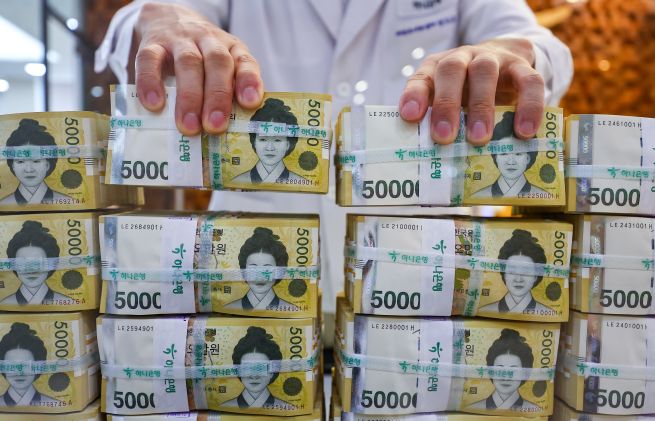
This drop marks the largest depreciation since September 2022, when the won was destabilized by the “Legoland crisis,” pushing the won-dollar exchange rate above ₩1,440. (Yonhap)
SEOUL, Jan. 26 (Korea Bizwire) — The South Korean won experienced its steepest decline in real effective exchange rate (REER) in over two years last December, following political instability that shook financial markets.
According to data released by the Bank for International Settlements (BIS) on January 26, South Korea’s REER index stood at 91.03 (2020=100) at the end of December, down 1.99 points from the previous month.
The REER measures a currency’s purchasing power relative to other currencies, adjusted for inflation. A figure below 100 suggests undervaluation compared to the base year. The won’s December value, significantly below this threshold, indicates a heavily undervalued state.
Among 64 countries tracked by the BIS, South Korea’s REER ranked second-lowest after Japan (71.3), which continues to face a weak yen. The won’s monthly decline of 1.99 points was the third largest globally, trailing Brazil (-3.94 points) and Australia (-2.37 points).
This drop marks the largest depreciation since September 2022, when the won was destabilized by the “Legoland crisis,” pushing the won-dollar exchange rate above ₩1,440. In December 2024, the won’s value against the U.S. dollar fell 5.3%, the second sharpest drop among major currencies, following Russia’s ruble (-6.4%).
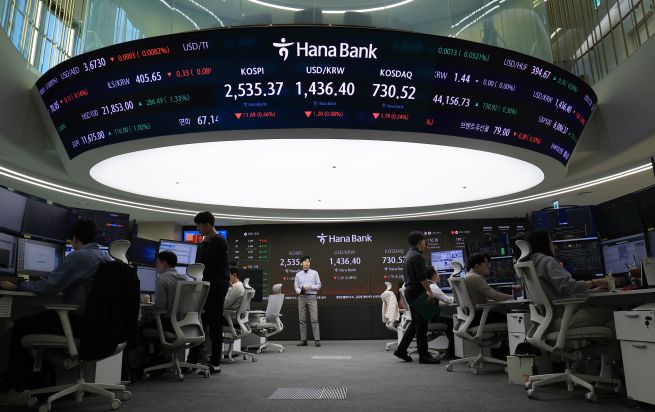
Dealers are seen working at the dealing room of Hana Bank’s headquarters in Jung-gu, Seoul, on the morning of January 23. (Yonhap)
The currency’s devaluation coincided with heightened political uncertainty following the imposition of martial law on December 3, which caused the exchange rate to spike to ₩1,442. By December 27, it had risen further to ₩1,486.7.
Experts attribute much of the won’s underperformance to domestic political instability. Bank of Korea Governor Rhee Chang-yong stated earlier this month that political factors contributed to a ₩30 rise in the exchange rate beyond what fundamentals would dictate.
A central bank official added, “The significant drop in the REER reflects the won’s relative weakness not only against the dollar but also other major currencies. Political uncertainties have undeniably played a role in this underperformance.”
Despite the volatility, analysts cautioned against overinterpreting short-term REER fluctuations. “Comparing REERs across countries can be noisy and less meaningful due to differences in trade structures and exchange rate regimes,” the official noted.
As South Korea navigates 2025, the interplay between domestic political stability and global economic trends will be pivotal in shaping the trajectory of the won and the broader financial markets.
Ashley Song (ashley@koreabizwire.com)