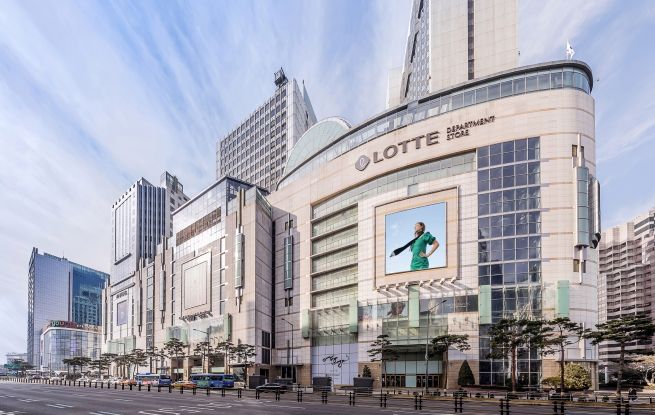
Lotte Department Store Main Branch (Image provided by Lotte Department Store)
SEOUL, May 13 (Korea Bizwire) — South Korea’s department store sector suffered a difficult first quarter as sluggish domestic consumption weighed heavily on sales and profits, with only Lotte Department Store managing to post a notable profit boost, thanks to strong performance in overseas operations and internal restructuring efforts.
According to industry data released Tuesday, Lotte Department Store saw its operating profit jump 44.3% year-on-year to 130 billion won in the first quarter of 2025, despite a slight 1.1% dip in revenue to 806.3 billion won.
The company credited the improvement to aggressive cost-efficiency measures—including the closure of underperforming stores and reinvestment in flagship locations—as well as a strong showing from its international business, which saw a 6.2% rise in revenue and returned to profitability.
By contrast, competitors Shinsegae and Hyundai Department Store both fell short of expectations. Shinsegae’s revenue slipped 0.8% to 659 billion won, with operating profit down 5.1% to 107.9 billion won. Hyundai also reported a 0.8% decline in sales to 589 billion won and a 5.7% drop in operating income to 97.2 billion won.
The downturn was attributed to weak performance across nearly all product categories amid deepening consumer pessimism and a colder-than-average winter that hurt fashion sales—a category that typically accounts for up to 50% of annual department store revenue.
“Political instability triggered by emergency rule, heightened trade uncertainty from U.S. tariff actions, and erratic weather all worked against us,” said one department store industry official, noting the convergence of domestic and global headwinds.
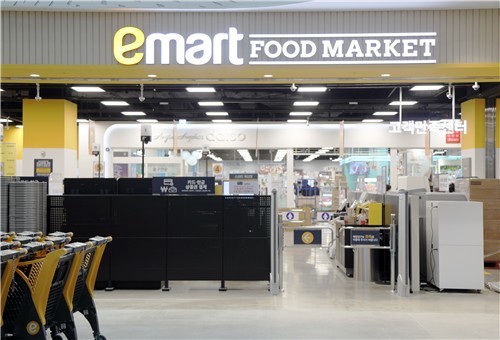
E-Mart Food Market Godeok Branch (Image provided by E-Mart)
Meanwhile, in the big-box retail sector, market leader E-Mart posted a stellar first quarter. On a standalone basis, the company’s revenue surged 10.1% year-on-year to 4.63 trillion won, while operating profit soared 43.1% to 133.3 billion won—its best quarterly performance since 2018.
Executives attributed the result to rising foot traffic at both its standard discount stores and warehouse-style Traders locations, signaling a rebound in consumer interest in offline shopping despite ongoing economic uncertainty.
In contrast, Lotte Mart saw its revenue edge up just 0.3% to 1.49 trillion won, while operating profit plunged 34.8% to 28.1 billion won. Stripping out overseas earnings, domestic operating profit plummeted 73.6% from a year earlier.
Both E-Mart and Lotte Mart emphasized low-price strategies through centralized purchasing, but analysts noted that E-Mart’s larger scale gave it a stronger edge in passing savings onto consumers. E-Mart’s aggressive promotions—including its “Price Shock Declaration” and “Great Eat Festa”—were widely seen as contributing to its outperformance.
“As integrated purchasing intensifies, the retailer with greater volume naturally holds an advantage in reducing procurement costs,” said one supermarket industry official. “If Lotte Mart rolls out large-scale discounts to regain ground, we could see an all-out promotional war unfold in the second half of the year.”
Ashley Song (ashley@koreabizwire.com)