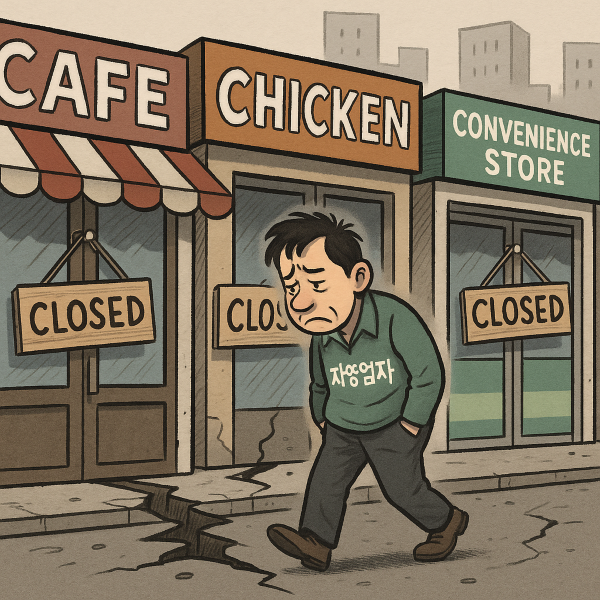
Korea’s Self-Employment Sector Shrinks as Coffee Shops, Eateries Close Down (Image supported by ChatGPT)
SEOUL, May 26 (Korea Bizwire) — For the first time since statistics began in 2018, South Korea’s once-booming coffee shop sector has shrunk, alongside a broader pullback across key self-employment industries. The decline underscores mounting pressure on small business owners from domestic economic stagnation, market saturation, and rising operating costs.
According to data released Sunday by the National Tax Service’s TASIS portal, the number of registered coffee and beverage shops fell to 95,337 in the first quarter of 2025 — a drop of 743 from a year earlier. The decrease marks a historic reversal in growth, even during the pandemic years when café numbers had continued to climb.
From just 45,203 shops in early 2018, the sector ballooned to 96,080 by early 2024. But this year, that expansion has come to a halt.

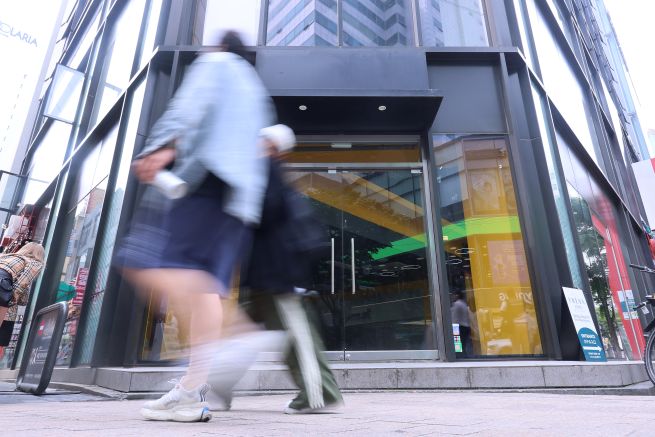
According to the “December 2024 and Annual Industrial Activity Trends” report released by Statistics Korea on February 3, retail sales, which reflect goods consumption, declined by 2.2%. This marks the largest drop in 21 years, since the 3.2% decline in 2003 during the credit card crisis. The photo shows a noticeably quieter-than-usual Myeongdong shopping district in Seoul. (Yonhap)
Wider Declines Across Food and Retail Sectors
The downturn isn’t limited to cafés. Chicken and pizza shops fell by 180, Korean and Chinese restaurants by 484 and 286 respectively. Bars — particularly vulnerable amid changing drinking culture — experienced a sharp 1,802-unit contraction in the first quarter.
Retailers are also under strain. Clothing stores dropped by nearly 3,000 year-on-year to 82,685, and cosmetics shops fell by over 1,500 to 37,222.
Even convenience stores — long considered a stable post-retirement business — saw a rare drop, falling by 455 to 53,101 locations.
Economists point to a confluence of structural weaknesses: oversupply in self-employment, shrinking domestic consumption, and increased cost burdens from third-party delivery platforms. Aging entrepreneurs, often without specialized post-retirement skills, have flooded saturated markets such as fried chicken and convenience retail — only to face mounting closures.
A report from Korea Credit Data (KCD) showed that the average revenue per small business in Q1 2025 was 41.79 million won, down 0.72% from a year earlier. The steepest declines came from bars (-11.1%), snack bars (-7.7%), bakeries and dessert shops (-4.9%), fast food (-4.7%), and cafés (-3.2%).
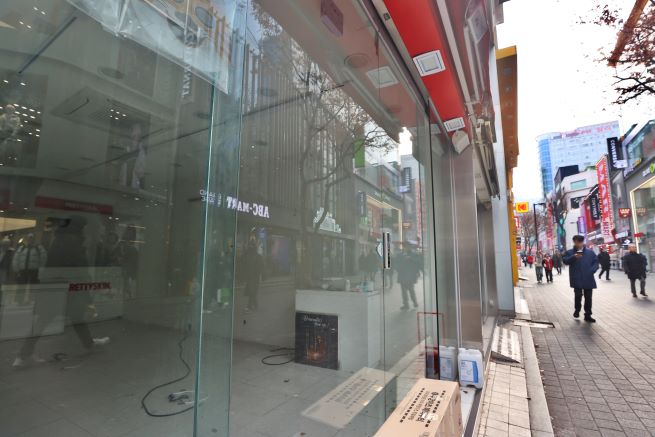
A view of vacant retail spaces on the streets of Myeong-dong, Seoul. (Yonhap)
Surge in Business Closures and Support Requests
As financial stress deepens, more business owners are shutting down. Government data shows 23,785 applications for “one-stop closure support” in Q1 2025 — a 64.2% surge from the same period in 2024.
“The Korean self-employment model is characterized by high rates of entry and exit,” said Kim Kwang-seok, an economist at the Korea Economic Industry Institute. “Now, for the first time, closures are outpacing new openings.”
Lee Jung-hee, an economics professor at Chung-Ang University, added, “While some entrepreneurs close with a plan, many are simply pushed to the edge. And the broader job market isn’t offering enough quality alternatives.”
As loan delinquency rates among self-employed individuals continue to rise, the number of businesses closing due to overwhelming debt burdens is steadily increasing. (Yonhap)
Education and Wellness Sectors Defy the Trend
Despite widespread contractions, some service industries continue to grow. Personal wellness and education-related businesses saw notable gains in Q1.
Skin care shops added 4,909 locations, gyms 702, private academies 1,910, and tutoring centers 3,374. Even professional services such as law, accounting, and tax firms recorded modest increases.
As of Q1 2025, South Korea had 3.07 million active businesses across 100 key self-employment sectors — a year-on-year increase of about 39,500. However, this growth is notably slower than in prior years, reflecting a broader deceleration in small business dynamism.
The latest data signals a growing divide: while some niche service sectors thrive, the bulk of everyday storefront businesses are being squeezed out by economic forces that show little sign of easing.
M. H. Lee (mhlee@koreabizwire.com)