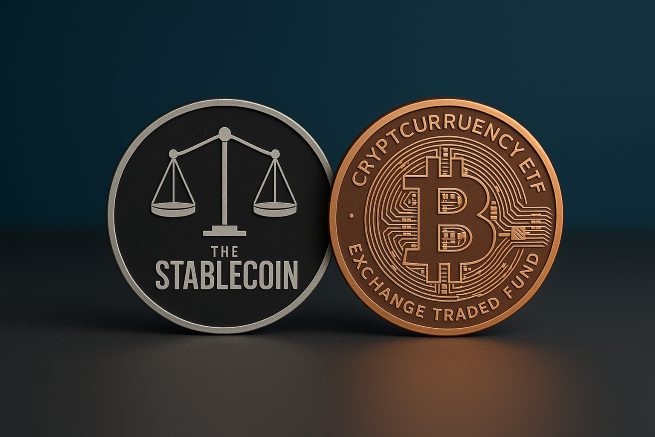
A stablecoin is a type of cryptocurrency issued with a fixed value pegged to a traditional currency such as the U.S. dollar. (Image provided by the stablecoin and digital asset industry.)
SEOUL, June 11 (Korea Bizwire) —As South Korea’s ruling Democratic Party accelerates efforts to legalize and regulate won-based stablecoins, industry insiders warn that a hasty rollout could expose the financial system to disorder and weaken the country’s global competitiveness.
In a move reflecting growing pressure from lawmakers, a consortium of major South Korean banks — including KB Kookmin, Shinhan, Woori, NH Nonghyup, IBK Industrial Bank, and Suhyup Bank — is pushing ahead with plans to jointly issue a won-pegged stablecoin. The initiative is being led by the Open Blockchain & DID Association (OBDIA), a nonprofit body backed by the banks.
According to financial industry sources, the banks are exploring the establishment of a jointly funded subsidiary that would issue the stablecoin. The structure would mirror similar efforts underway in the United States, where major players like JPMorgan Chase, Bank of America, and Citibank are discussing cooperative stablecoin ventures.
Proponents argue that a unified banking approach could help reduce operational costs, spread risk, and allow for more cohesive responses to regulatory challenges. Scaling up would also be crucial in positioning the Korean won-backed stablecoin as a credible competitor to dollar-dominated tokens like USDT and USDC.
However, sources acknowledge that major hurdles remain. Internal decision-making processes at individual banks are often slow, and interbank coordination on funding contributions, coin design, and operational protocols is expected to take considerable time. As one industry official put it, bringing a coin to market will be “a mountain beyond mountains.”
Meanwhile, the Democratic Party is pressing ahead with its proposed Digital Asset Framework Act, which could open the door for non-bank entities to issue stablecoins as early as late 2025 or 2026. The bill, which is expected to become party policy, allows any South Korean company with over 500 million won ($370,000) in capital to apply for a license from the Financial Services Commission to issue a won-pegged stablecoin.
Critics warn that such a low bar for entry could lead to a flood of underprepared fintech firms entering the market. Many lack the robust anti-money laundering (AML) and know-your-customer (KYC) systems that are standard in traditional banking, potentially increasing the risk of financial crime and cyberattacks.
The Bank of Korea has repeatedly expressed skepticism about allowing non-banking institutions to issue stablecoins, citing concerns about financial stability and systemic risk. Industry analysts have echoed these worries, noting that a poorly designed or insecure token could trigger liquidity crises during periods of mass redemptions.
There are also broader strategic concerns. Observers note that stablecoins issued by small domestic fintech firms are unlikely to gain traction internationally, undermining the goal of enhancing South Korea’s monetary sovereignty in a market dominated by U.S. dollar-backed digital assets.
“If a won-based stablecoin fails to get listed on major overseas exchanges, its impact will be negligible,” one industry insider said.
As the race to launch a won-pegged stablecoin heats up, South Korea faces a delicate balancing act: promote innovation and speed while preserving market order and global credibility.
M. H. Lee (mhlee@koreabizwire.com)