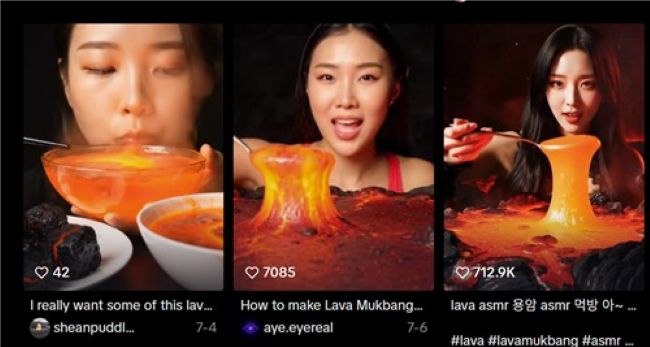
AI-Generated Lava Mukbang Trend.(Image from TikTok)
SEOUL,July 22 (Korea Bizwire) — A new wave of AI-generated “mukbang” (eating broadcast) content is taking South Korea by storm — and splintering public sensibilities in the process. From people consuming lava and jewels to animations of dogs and cats being eaten with chopsticks, the rise of surreal, grotesque food videos is challenging both ethical boundaries and traditional internet culture.
At the heart of the trend is Google’s video-generating AI, Veo3, which allows users to create hyper-realistic clips of humans consuming the unthinkable — glowing lava, crystal-laced cakes, cloud-shaped fruits, and even objects resembling live animals. Once considered immune to automation due to its sensory intimacy, the mukbang genre is now being reshaped by AI’s creative shock value.
“It’s mesmerizing, but it feels like my lifetime of common sense is breaking down,” said one 30-something viewer.
The most controversial subgenre is known as “AI grotesque food”, where creators produce short-form videos of impossible — and often disturbing — meals. These clips are spreading rapidly on platforms like YouTube and TikTok, driven by the combination of unusual visuals and tactile sound effects mimicking slurping, crunching, or sizzling.
Some real-life content creators have even begun “fighting back” by parodying AI videos. One YouTuber’s spoof of an AI-generated lava-eating video racked up over 6 million views, while TikTok users have created DIY recipes that simulate molten lava using syrup, food coloring, and torches.
Still, concerns are mounting. Unfiltered AI content, including videos of animated humans consuming live dogs, cats, or worms, have circulated freely — prompting an outcry from users demanding stronger platform oversight. “Even if it’s fake, this crosses the line,” wrote one viewer.
Experts warn that these videos present a new dimension of digital harm, distinct from the now-familiar dangers of deepfakes. “AI-generated grotesque mukbangs raise questions about content ethics, user desensitization, and platform accountability,” said Lee Sung-yeop, a professor at Korea University’s Graduate School of Technology Management.

Creating “Lava” with Corn Syrup and Marshmallows.(Image from the TikTok video user @sophiesophss)
In response, YouTube is tightening monetization rules for low-quality or mass-produced AI content. While exact policies remain vague, the company has started flagging repetitive AI-generated material, suggesting that creators who rely on quantity over originality could be excluded from ad revenue.
YouTube content chief Rene Ritchie downplayed fears of broad censorship, calling the new approach “a fine-tuning measure to better detect repetitive content” rather than a sweeping crackdown on AI video.
Still, legal and regulatory responses remain sluggish. South Korea has no specific laws governing AI-generated visual content, despite its increasing realism and reach. Experts are calling on platforms to reinforce community guidelines and for governments to step in with administrative guidance or future regulation.
“This is no longer just a free speech issue,” said Lee. “When generative AI enables disturbing or harmful content at scale, the responsibility lies not only with the creator, but also with the AI developers and the platforms that distribute it.”
As AI creativity tests the boundaries of taste, legality, and realism, South Korea finds itself at the forefront of a global debate over what the future of digital expression should — and should not — look like.
Lina Jang (linajang@koreabizwire.com)