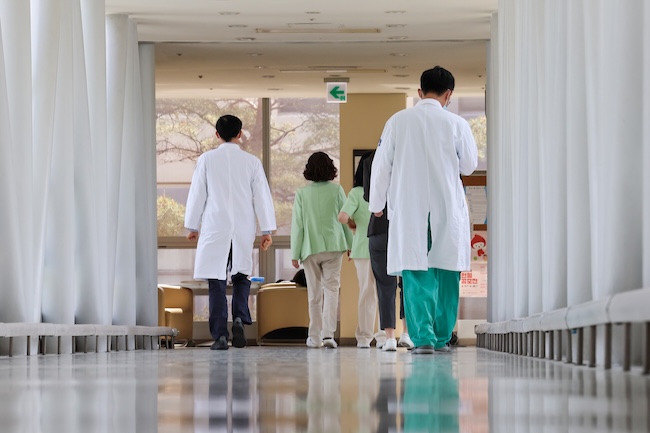
Medical staff walk through a hospital corridor in Seoul. (Image courtesy of Yonhap)
SEOUL, July 30 (Korea Bizwire) — South Korea has one of the lowest numbers of practicing physicians among developed nations, but its citizens visit the doctor more often than anywhere else in the OECD, highlighting a paradox of limited manpower and high demand in the nation’s healthcare system.
According to the OECD Health Statistics 2025 report released Wednesday by South Korea’s Ministry of Health and Welfare, the country had just 2.66 practicing doctors per 1,000 people in 2023—the second lowest among OECD member states, just above Japan (2.65). The OECD average stands at 3.86.
South Korea also ranks third-lowest in the number of medical graduates, with 7.4 graduates per 100,000 people, trailing only Israel and Canada, and far below the OECD average of 14.3.
The nation’s nursing workforce also falls slightly below average, with 9.5 nurses and nursing assistants per 1,000 people compared to the OECD average of 9.7. Notably, the number of registered nurses alone was just 5.2, significantly lower than the OECD average of 8.4. However, South Korea is producing new nursing graduates at a rapid pace, with 46.0 graduates per 100,000 people—well above the OECD average of 35.0.
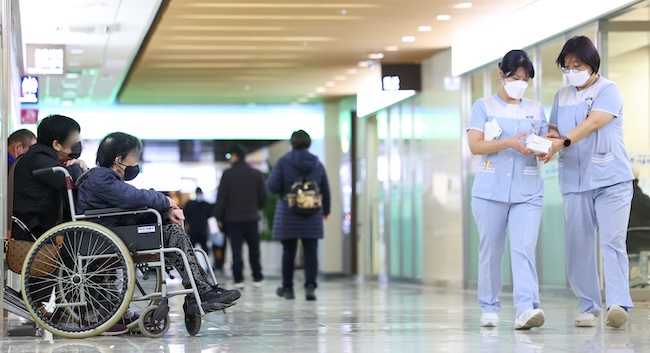
Patients wait at a state-run hospital in Seoul on Feb. 22, 2024. (Image courtesy of Yonhap)
Despite its staffing shortfalls, South Korea boasts world-class access to medical care. The average Korean visited a doctor 18 times in 2023, nearly three times the OECD average of 6.5. Japan followed with 12.1 visits, while countries like Mexico and Sweden reported fewer than three.
The country also leads in hospital infrastructure, with 12.6 beds per 1,000 people, tripling the OECD average of 4.2. For acute care specifically, South Korea maintains 7.4 beds per 1,000, more than double the OECD average of 3.4.
South Korea is equally well-equipped in diagnostic technology. The nation had 38.7 MRI machines and 45.3 CT scanners per million people, both significantly higher than the OECD averages. While MRI usage was modest, CT scans reached 333.5 per 1,000 people, the highest in the OECD.
South Koreans also stayed in hospitals longer than most. The average length of stay per inpatient was 17.5 days, second only to Japan, and more than double the OECD average of 8.1. Even for acute conditions, the average stay was 7.2 days, compared to the OECD’s 6.5.
One area of notable concern is the country’s cesarean delivery rate, which reached 610.6 per 1,000 live births in 2022—more than double the OECD average and the highest among all member countries.
A health ministry official noted that South Korea’s geographic accessibility and universal health insurance system contribute to the high utilization of medical services, despite the relative scarcity of doctors.
The report underscores South Korea’s urgent need to expand and reform its medical workforce to meet the growing demand and sustain its high standard of healthcare access.
Lina Jang (linajang@koreabizwire.com)