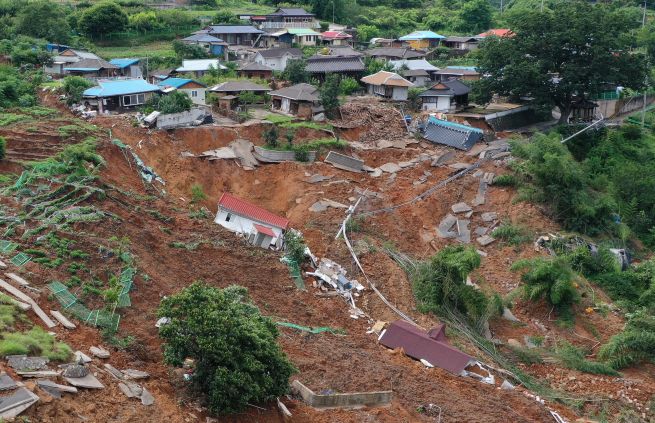
On the afternoon of July 21, a village located along Sangneung-ro at the foot of a mountain in Saengbiryang-myeon, Sancheong County, South Gyeongsang Province, lies buried in the aftermath of recent heavy rains and a landslide. (Yonhap)
SANCHEONG, August 4 (Korea Bizwire) — In the aftermath of back-to-back disasters, the rural county of Sancheong in South Gyeongsang Province finds itself overwhelmed, under-resourced, and emblematic of a broader crisis facing South Korea’s depopulating regions.
Slammed first by a massive wildfire in March and then by record-breaking rains in July that dumped nearly 800 mm over four days, Sancheong has suffered catastrophic losses. Eleven towns across the county were devastated by landslides, floods, and infrastructure collapses. Fifteen residents were either killed or went missing — most of them elderly — as torrents swept away homes and entire communities.
With damages estimated at over 475 billion won ($368 million), Sancheong accounts for the majority of the 749.7 billion won in total disaster losses reported across Gyeongsang Province. Yet the road to recovery is proving painfully slow, hindered by a shortage of both manpower and funding.
“Our population is mostly seniors. If outside volunteers stop coming, we worry how we’ll complete the recovery,” said a senior official in the county government.
Sancheong is a designated depopulation zone and one of the nation’s most rapidly aging regions.
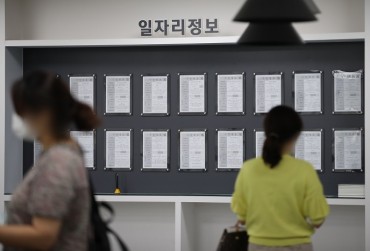
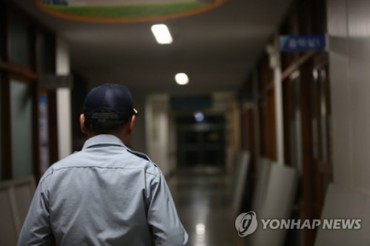
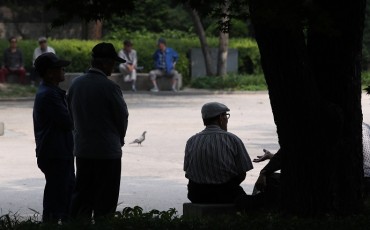
Of its 33,200 residents, more than 40% are aged 65 or older. The county’s population density is extremely low, with fewer people spread over an area 1.3 times the size of Seoul. In 2023, births totaled just 64, while deaths reached 587, signaling a deepening demographic spiral.
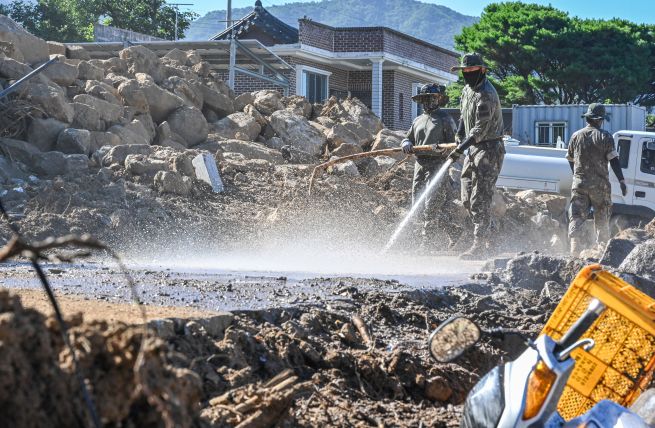
On July 28, soldiers from the Army’s 39th Division clean and maintain roads using a water truck in Sancheong, South Gyeongsang Province. (Photo courtesy of the Republic of Korea Army)
The demographic crisis is matched by fiscal fragility. Sancheong’s fiscal self-reliance rate was a mere 8.49% in 2023, with just 567 billion won of its 6.7 trillion won in revenue coming from its own sources. The lack of working-age taxpayers means the county is heavily dependent on central government support.
While the national government has designated Sancheong and neighboring Hapcheon as special disaster zones and disbursed 40 billion won in emergency aid, local officials say long-term recovery — particularly of public infrastructure such as levees, roads, and water systems — will far exceed available resources.
Other disaster-struck counties in the region, including Hapcheon, Uiryeong, Hadong, and Hamyang, face similar challenges as aging, depopulated communities with low fiscal autonomy.
Policy experts are calling for a more flexible use of the national Local Extinction Response Fund, currently earmarked for community revitalization and economic development. “Disaster response is a basic responsibility of the state,” said Oh Dong-ho, head of the Gyeongnam Research Institute. “The fund should be allowed to support recovery efforts in depopulated areas.”
Kwon-wook Ahn, co-chair of Local Autonomy Solidarity in Gyeongnam, echoed the urgency. “These communities lack the capacity to cope on their own. This disaster clearly shows the need for stronger disaster-readiness capabilities from both the central and provincial governments.”
Lina Jang (linajang@koreabizwire.com)