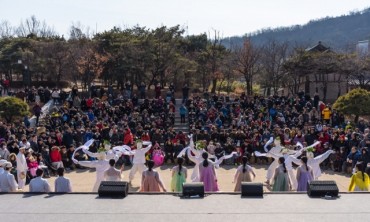
New government data show first marriages delayed by six years in three decades, with one-person households becoming the country’s second-largest family type. (Yonhap)
SEOUL, Aug. 27 (Korea Bizwire) — South Koreans are marrying later, living more often in single-person households, and reporting higher life satisfaction than in past decades, even as chronic illness and suicide remain persistent challenges, new government data show.
A report released Wednesday by Statistics Korea’s National Statistical Research Institute traced sweeping social changes since the early 1990s, underscoring the country’s rapid demographic and cultural transformation.
The average age at first marriage rose by more than six years in just over three decades, reaching 33.9 for men and 31.6 for women in 2024, compared with 27.8 and 24.8 in 1990. Once common in the twenties, marriage now typically takes place in the early to mid-thirties.
At the same time, the country’s fertility rate has remained below replacement level since the early 1980s, with an era of “ultra-low fertility” stretching back more than 20 years.
Household structures have shifted accordingly: single-person households accounted for just a fraction of the population in 1990 but reached 35.5 percent in 2023, second only to two-person households. Multi-generational households, once dominant, have nearly disappeared.
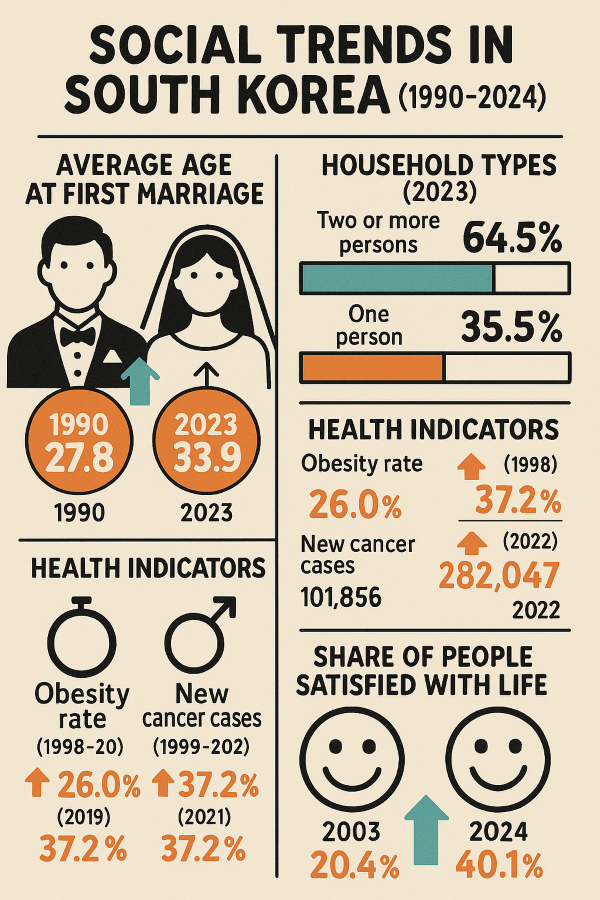
Later marriages, shrinking families, rising illnesses and a modest uptick in happiness reflect the country’s rapid social transformation. (Image supported by ChatGPT)
Health data highlight another profound shift. The obesity rate climbed from 26 percent in 1998 to 37.2 percent in 2023, while high cholesterol diagnoses more than tripled since 2005.
Cancer cases, the country’s leading cause of death, nearly tripled from 101,856 in 1999 to 282,047 in 2022. Suicide rates surged during the 2000s, peaking at 31.7 per 100,000 in 2011 before easing to 27.3 in 2023, though rates remain especially high among older adults.
Despite these strains, South Koreans are expressing greater life satisfaction. In 2003, only 20.4 percent of respondents described themselves as satisfied with their lives.
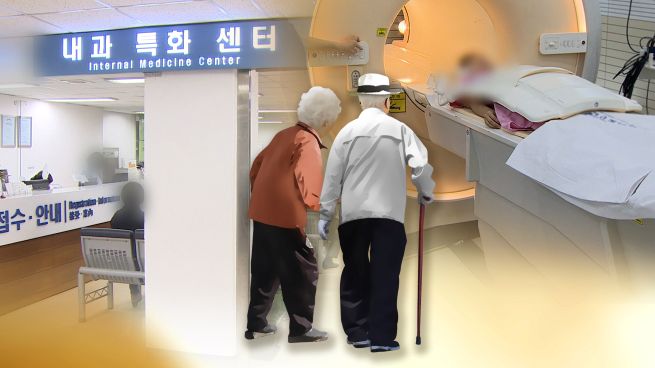
Obesity and Cancer Rates Climb as Korea’s Population Ages (Yonhap)
By 2024, the figure had nearly doubled to 40.1 percent — still below half, but a sharp improvement.
Another 47.2 percent reported feeling “average,” while 12.7 percent said they were dissatisfied. Measures of happiness also rose modestly over the past decade, while reported anxiety and depression edged down slightly.
The findings paint a portrait of a society in flux: wealthier, older, and more individualistic, yet still grappling with health risks and fragile well-being.
Lina Jang (linajang@koreabizwire.com)