

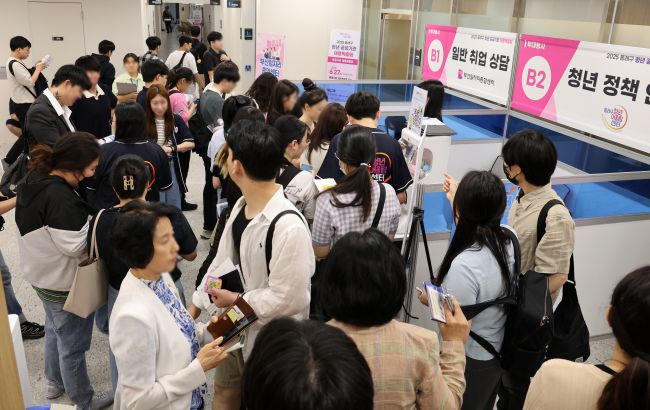
A job fair in Busan, some 325 kilometers southeast of Seoul, is filled with job seekers in this June 27, 2025, file photo. (Image courtesy of Yonhap)
SEOUL, Sept. 8 (Korea Bizwire) — For the first time, older workers now make up a larger share of full-time employees at South Korea’s major corporations than younger recruits, underscoring the deepening generational divide in the country’s labor market.
A report released Sunday by the Korea Employers Federation found that employees aged 55 to 59 in large companies increased nearly fivefold over the past two decades, rising from 42,000 in 2004 to 247,000 in 2024.
By contrast, employment among younger workers aged 23 to 27 slipped slightly, from 196,000 to 193,000 over the same period.
As a result, the proportion of older workers in regular corporate jobs climbed from 2.9 percent to 9.3 percent, overtaking the share of young employees, which fell from 13.7 percent to 7.3 percent.
The trend was even starker at unionized firms. In those workplaces, the number of older employees surged more than sevenfold to 216,000, while youth employment edged down to 121,000. Older workers now account for 10.7 percent of unionized corporate jobs, compared with just 6 percent for younger ones.

South Korean companies are redefining the qualities they seek in employees. (Image courtesy of Yonhap)
The federation warned that the demographic shift has intensified competition for jobs between generations, further raising barriers for young people trying to enter the workforce.
Average job tenure at large companies has lengthened from 10.4 years in 2004 to 12.1 years in 2024, while the share of new hires dropped from 9.6 percent to 6.5 percent.
Smaller firms and non-regular positions showed greater mobility: average job tenure rose from 3.8 years to 5.7 years, but turnover and hiring rates remained relatively high. Wage gaps, however, persisted.
Last year, workers in small and non-regular jobs earned just 58 percent of the pay of full-time employees at large corporations, a ratio little changed from two decades ago.
“Our labor market remains split between a privileged 12 percent in large corporate jobs, protected by labor laws and benefits, and the 88 percent in smaller firms or temporary posts with far weaker safeguards,” said Lim Young-tae, head of employment and social policy at the federation.
He called for greater flexibility in corporate jobs and stronger safety nets for precarious workers to dismantle what he described as South Korea’s entrenched “dual labor structure.”
Ashley Song (ashley@koreabizwire.com)




Well, surely it is only thanks to this group of older ‘privileged’ workers that many ‘young underprivileged’ were able to attend university. About 400,000 ‘underprivileged young’ are not in training or education or working or seeking employment. Whose money are they mostly relying on to ‘rest’, I wonder?!