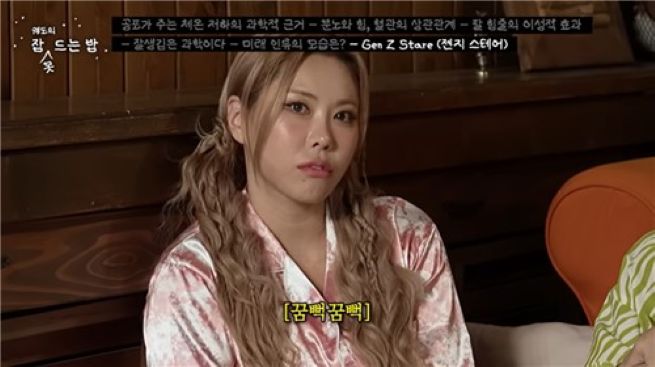
Dancer Gabi reenacts the “Gen Z Stare” on a variety show (Image source: YouTube channel ‘Yoo Byung-jae’ video capture).
SEOUL, Sept. 8 (Korea Bizwire) — A silent, vacant look from younger workers — dubbed the “Gen Z Stare” — is rattling South Korean campuses and offices, becoming a flashpoint in the country’s ongoing debate over generational communication.
The term, which fuses “Gen Z” with “stare,” describes the expressionless gaze of young people born between 1997 and 2006 when asked a question or given an instruction.
First popularized in the United States to mock disengaged employees, the phrase has since gone viral on social media platforms like TikTok and YouTube, where countless parodies continue to circulate.
At one Seoul university, staff say student workers often respond to directions not with words, but with a long, blank look. “I thought the student was ignoring me,” one administrator said. “Later I learned many colleagues had experienced the same thing.”
Similar complaints have surfaced online, with older employees expressing confusion and frustration over younger colleagues who remain silent even when corrected for mistakes.
Experts say the behavior reflects how Gen Z, raised in the era of smartphones, has grown more comfortable with text-based messaging than face-to-face exchanges.
A survey of 765 young people last year by part-time job portal Alba Heaven found that nearly 74 percent preferred texting, compared with just 11 percent who favored phone calls. Four in ten said calls made them anxious or fearful.
Scholars caution against interpreting the trend as rudeness. Instead, they frame it as a new communication style shaped by digital environments and the disruptions of the pandemic.
“We need to show patience, as though waiting out a lag,” said Lim Myung-ho, a psychology professor at Dankook University. “At the same time, schools should offer more opportunities for direct communication training to help younger generations adapt.”
What began as an internet meme has thus become a mirror for South Korea’s wider struggles with workplace hierarchy, etiquette and shifting cultural norms across generations.
Lina Jang (linajang@koreabizwire.com)