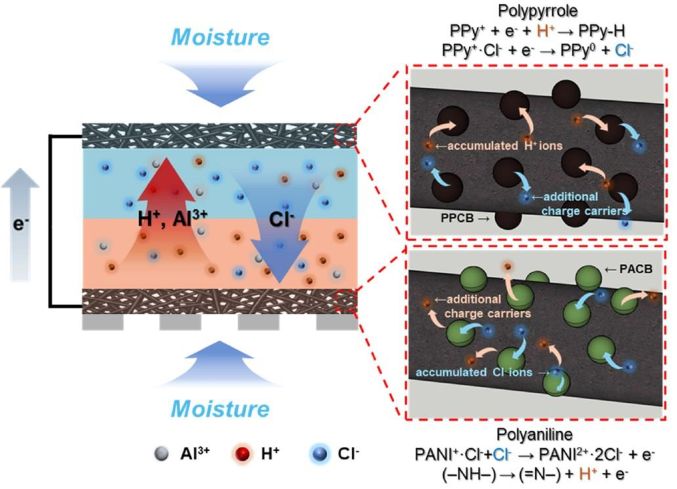
POSTECH Engineers Boost Moisture-Powered Electricity Output by 100 Times (Image courtesy of POSTECH)
POHANG, Sept. 26 (Korea Bizwire) — Pohang University of Science and Technology (POSTECH) scientists have developed a device that generates electricity from ambient humidity with more than 100 times the efficiency of previous technologies, marking a potential leap forward in renewable energy.
The research team, led by Professor Jeon Sang-min of POSTECH’s Department of Chemical Engineering, announced Wednesday that it had created a “cascade ion-redox amplification mechanism” that dramatically extends both the power output and operating time of so-called moisture generators.
Humidity, from human breath to airborne water vapor, has long been recognized as a possible energy source, but conventional devices rapidly lost efficiency. As ions dispersed, their concentration fell, while accumulated ions blocked further diffusion, sharply curbing performance.
The POSTECH team designed a new device by layering negatively and positively charged polymers and binding conductive polymers to carbon electrodes. When exposed to moisture, the device triggers a chain reaction that sustains ion flow and amplifies charge generation.
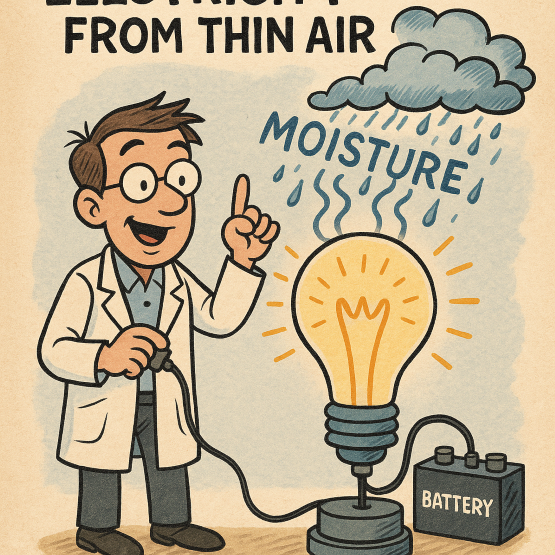
South Korean Scientists Harness Air Moisture to Generate Power at 100-Fold Efficiency (Image supported by ChatGPT)
In tests, the device produced roughly 100 times the output of previous models. Eight units connected in series generated 9 milliwatts of electricity, enough to power Bluetooth earphones.
Unlike solar or wind power, the system works in any environment where air is present, offering potential applications ranging from portable electronics to self-powered sensors.
The findings were published in the journal Nano Energy.
“Moisture in the air is an infinite resource,” Jeon said. “Our research takes us a step closer to practical and commercial use of eco-friendly self-powering technology.”
Kevin Lee (kevinlee@koreabizwire.com)