Girl group BLACKPINK performs the first London show of their world tour “Deadline” at Wembley Stadium in London on August 15 (local time).
LONDON, Oct. 5 (Korea Bizwire) — The University of Cambridge is introducing a new master’s program dedicated to East Asian popular culture — with a strong focus on Korean culture — reflecting the growing academic recognition of K-culture’s global influence.
The Faculty of Asian and Middle Eastern Studies announced on Sunday that it will begin offering a one-year MPhil course titled “East Asian Popular Cultures Across Time” in the 2026 academic year.
The program will explore popular culture in Korea, China, and Japan from premodern times to the present, examining how media, borders, and historical contexts have shaped cultural exchange and transformation.
Laura Moretti, co-head of the faculty, said the program’s interdisciplinary and cross-regional approach would enable “radically new ways of studying popular culture based on deep historical understanding.”
Although not limited to Korean studies, the program is expected to devote substantial attention to the Korean Wave, or Hallyu, which has redefined global perceptions of contemporary East Asia. Students will study East Asian cultural traditions before delving into the rise of K-pop, film, and television as worldwide phenomena.
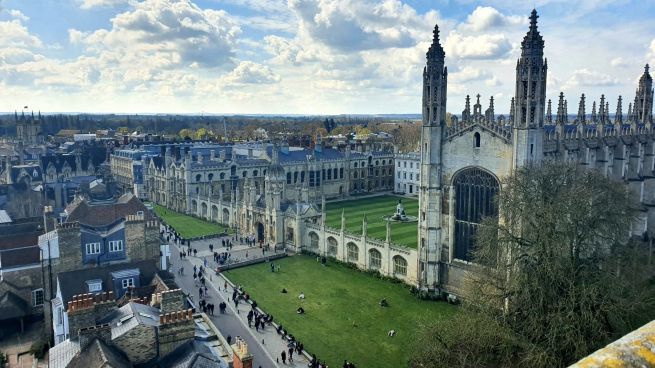
A view of the University of Cambridge campus in the United Kingdom (Photo courtesy of Professor Kim Nuri, University of Cambridge).
“The rise of Korean popular culture was the key reason this program was established,” said Professor Kim Nuri, a Korean studies scholar at Cambridge. “It’s not easy to gain approval for a new program at a traditional university like Cambridge, but the growing importance of Korean pop culture made a compelling case.”
Cambridge plans to hire a new faculty member specializing in Korean popular culture to join its expanding Korean studies team, which currently includes Professor Kim, who teaches Korean history, and Professor John Nil-Wright, who focuses on Korean international relations.
Kim said increasing student demand played a major role in the university’s decision. “Even though my own expertise lies in history, many applicants wanted to study K-culture, and we felt we were missing out on talented researchers,” he said.
He added that while some view the Korean Wave as a passing phase, “we see it as a significant global phenomenon that deserves deep, serious study. Without understanding popular culture, it’s impossible to fully grasp modern life.”
The initiative also aligns with the broader expansion of Korean studies across Europe, where it has traditionally been overshadowed by Chinese and Japanese studies. The program aims to attract not only Korean speakers but also researchers and professionals from other fields who wish to engage with Korean culture through their own areas of expertise.
“We want this course to strengthen Korean studies,” Kim said. “It’s for people who may not speak Korean fluently but have rich knowledge or creative experience — cultural producers who can contribute new perspectives to the field.”
Kim, who earned his Ph.D. in history from Harvard University and previously held fellowships at the University of Pennsylvania and Johns Hopkins University, joined Cambridge in 2021 when the university first launched its graduate programs in Korean studies.
Lina Jang (linajang@koreabizwire.com)