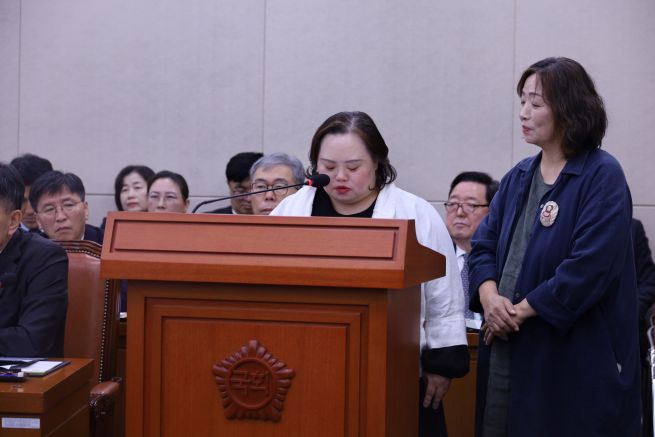
Actress and painter Jung Eun-hye, who has a developmental disability, attends the National Assembly audit session. On her right is her mother, artist Jang Cha-hyun-sil. (Photo courtesy of Yonhap)
SEOUL, Oct. 31 (Korea Bizwire) — Jung Eun-hye, a 35-year-old actress and painter with Down syndrome who rose to prominence through the hit drama Our Blues, appeared before South Korea’s National Assembly on Thursday to call for the passage of a special bill supporting stable, rights-based public jobs for people with severe disabilities.
Speaking as a witness during the Health and Welfare Committee’s audit session, Jung described how joining a “rights-centered public employment” program transformed her life. “Since 2021, I’ve been working as an artist, giving lectures, and raising awareness about the U.N. Convention on the Rights of Persons with Disabilities,” she said. “Before joining the program, I worked as a cleaner. Now I can do what I love, and it gives me joy and self-esteem.”
The program, which offers meaningful roles in advocacy, culture, and education for individuals excluded from traditional labor markets, currently lacks a permanent legal framework. Lawmakers have introduced a special act to formalize and expand it.
Jung shared her own story of isolation and recovery, recalling her twenties spent “in a cave-like room,” battling schizophrenia while her mother suffered a stroke. “Now my family lives because of me. My mom even uses my credit card,” she said. “I go to work every morning with my husband, paint with my colleagues, and eat lunch together. My job changed my life—but I worry it might disappear.”
Jung made headlines in May after marrying a colleague she met at her workplace for people with developmental disabilities.
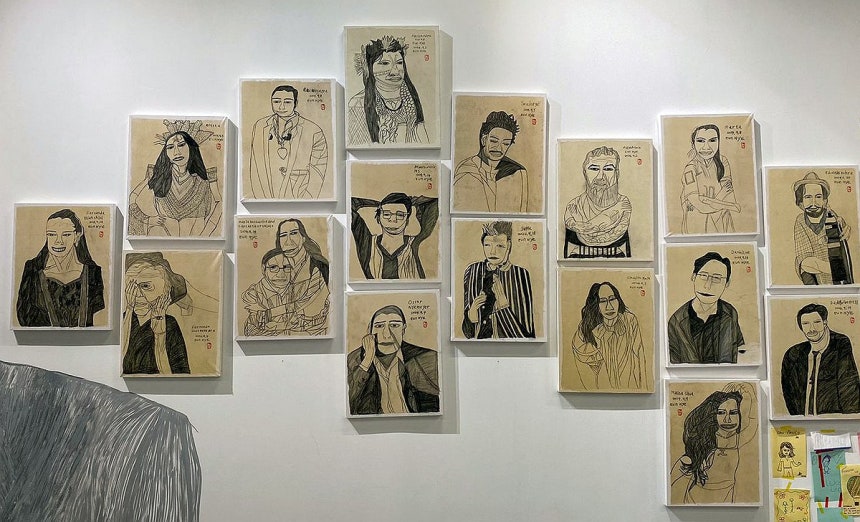
In October last year, Jung Eun-hye held a solo exhibition titled Amazing Grace at the Korean Cultural Center in Brazil, showcasing more than 70 works featuring animals and people. The exhibition received an enthusiastic response. (Photo courtesy of the Korean Cultural Center in Brazil)
She emphasized that many people with developmental disabilities still lack such opportunities. “Even Gyeonggi Province says there’s no budget for next year,” she said. “I want to keep working steadily through the special law.”
Health and Welfare Minister Jung Eun-kyung agreed that such employment should not be seen as welfare but as a path to dignity. “We must expand opportunities for people with disabilities to participate confidently in society,” she said, pledging to review local programs and cooperate with lawmakers.
Jung’s journey from isolation to national recognition mirrors the theme of empathy that defines her art. Known for her line, “You, you, you abandoned me, didn’t you?” in Our Blues, she later captured her reconciliation with the world in her 2022 illustrated memoir Eunhye’s Embrace. Since 2016, she has painted over 4,000 portraits at markets under a sign that reads, “I draw pretty faces not prettily.”
“When I hug someone, I feel warm,” she once said. “And when I’m warm, I feel happy. A hug is love.”
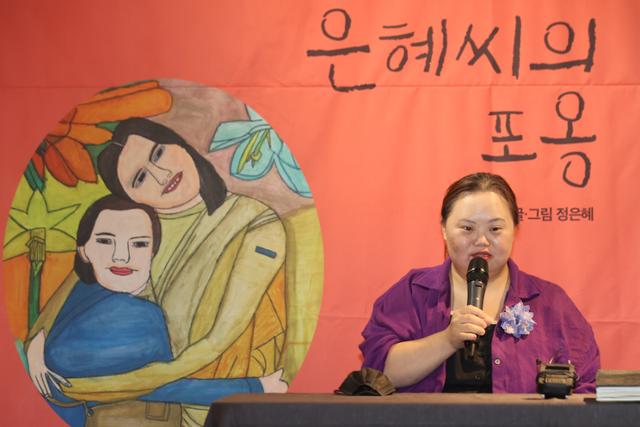
Jung Eun-hye, the artist, speaks at a press conference for the release of her illustrated essay Eunhye’s Embrace at Gallery Topohaus in Jongno-gu, Seoul, on August 24, 2022. (Photo courtesy of Yonhap)
Jung once struggled deeply with being born with Down syndrome, tormented by self-doubt and by how others looked at her. At 22, when her anxiety over others’ gazes became overwhelming, her mother—a professional illustrator—encouraged her to help with cleaning at her art studio, where she taught children.
One day, while surrounded by those young students, Jung picked up a pencil and began sketching a model she saw in a magazine. That drawing became her very first finished work.
In an interview last year, Jung reflected on what it means for people with disabilities to work. “It’s good when people with disabilities can work, become close with their coworkers, and not give up even when it’s hard,” she said. “We shouldn’t let go—we should keep working, earn money, get married, fall in love, and live our lives.”
“Through painting, I stopped being seen as a person with a disability and became an artist,” Jung said. “People call me a painter and appreciate my work. For me, painting is both art and a person. My dreams have all come true.”
Lina Jang (linajang@koreabizwire.com)