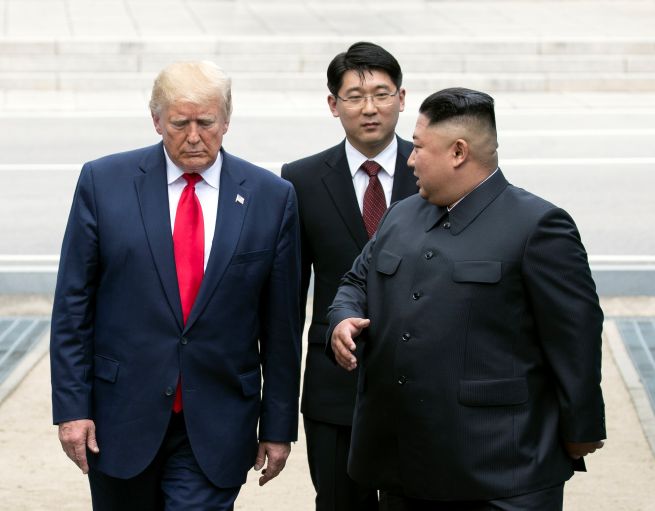
Donald Trump and Kim Jong-un at Panmunjom in 2019 (Image courtesy of Yonhap)
SEOUL, Dec. 6 (Korea Bizwire) — Both the United States and China have quietly omitted references to the “denuclearization of the Korean Peninsula” from major national security documents released in recent weeks, raising speculation over whether the two most influential actors in nuclear diplomacy with Pyongyang are recalibrating their approach.
The omission in Washington was notable. President Donald Trump’s latest National Security Strategy (NSS), released on December 5, did not mention North Korea or the goal of denuclearization — a sharp departure from both the Biden administration’s 2022 NSS and the document issued during Trump’s first term in 2017, both of which framed denuclearization as a central policy objective.
Traditionally, the NSS outlines an administration’s core security priorities and broad strategic direction. North Korea has routinely been identified alongside China, Russia and Iran as one of the United States’ principal security challenges.
Its absence in this year’s document has fueled questions in Seoul over whether Washington has deprioritized the long-standing goal of removing North Korea’s nuclear arsenal.
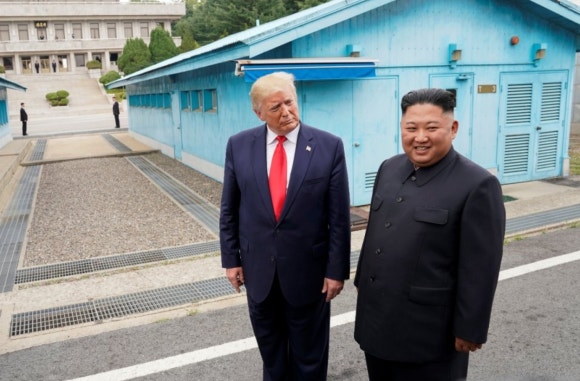
North Korean leader Kim Jong-un (R) and U.S. President Donald Trump across the Demarcation Line in the inter-Korean truce village of Panmunjom during their meeting on June 30, 2019
Analysts have offered competing explanations. Some see the omission as evidence that the Trump administration has downgraded denuclearization on its agenda. Others suggest it could reflect a desire to preserve diplomatic flexibility before any renewed talks with Pyongyang, avoiding language that could be seen as confrontational.
U.S. officials have insisted that the administration’s policy goal remains the “complete denuclearization of the Korean Peninsula,” a position reaffirmed in last month’s U.S.–South Korea leaders’ fact sheet.
The new NSS also removed broad references to global nuclear nonproliferation, adding to uncertainty about how the issue will be framed in future policy documents. Observers expect the forthcoming National Defense Strategy to address nuclear threats more explicitly.
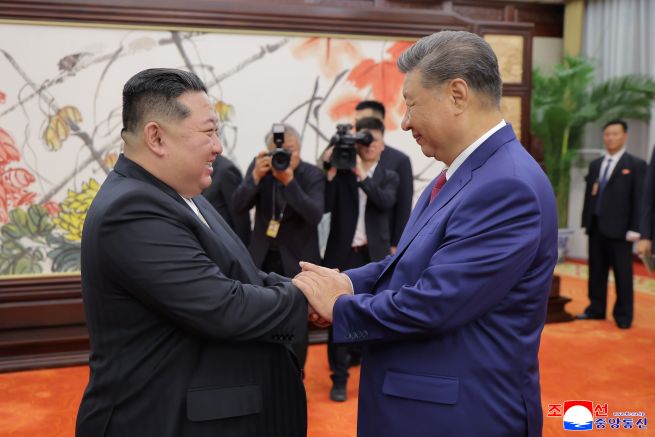
North Korean leader Kim Jong-un and Chinese President Xi Jinping. (Image source: Korean Central News Agency via Yonhap. For use only within South Korea; redistribution prohibited.)
China, meanwhile, made a similar shift. A new defense and arms-control white paper released on November 27 — titled China’s Arms Control, Disarmament and Non-Proliferation in the New Era — dropped language supporting the creation of nuclear-free zones, including one on the Korean Peninsula. The wording had appeared in the previous white paper published in 2005.
Instead, Beijing emphasized that it has maintained a “fair position” on Korean Peninsula issues, supports peace and stability, and urges all parties to halt pressure, resume dialogue and pursue a long-term political settlement.
The change adds to a broader pattern. Beijing has referenced denuclearization far less frequently in official statements and joint declarations than it did during the 2018–19 period of U.S.–North Korea diplomacy.
A trilateral summit declaration issued in Seoul last year by South Korea, China and Japan also omitted the goal of denuclearization — reportedly because of Chinese opposition.
Similarly, while Chinese President Xi Jinping and North Korean leader Kim Jong-un repeatedly referenced denuclearization in summit communiqués between 2018 and 2019, their most recent meeting in September did not include the term.
These shifts have stirred debate over whether China, amid intensifying strategic competition with the United States, is moving away from its long-held stance that North Korea must eventually relinquish its nuclear weapons.
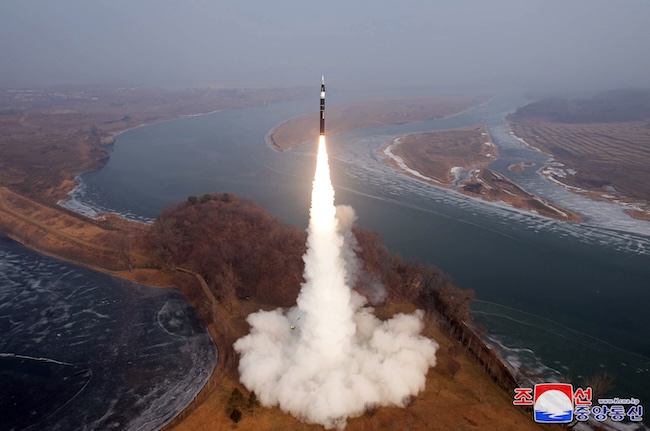
This photo, carried by North Korea’s official Korean Central News Agency on Jan. 7, 2025, shows the test-firing of a new intermediate-range hypersonic ballistic missile the previous day. (Image courtesy of Yonhap)
Some analysts suggest Beijing may now be tacitly accommodating North Korea’s nuclear status — not out of approval, but to limit U.S. influence in the region.
If so, Seoul may face a more complex diplomatic landscape: a Washington focused on broader regional deterrence and a Beijing increasingly reluctant to pressure Pyongyang, leaving denuclearization further from the top of either power’s agenda than at any point in years.
M. H. Lee (mhlee@koreabizwire.com)