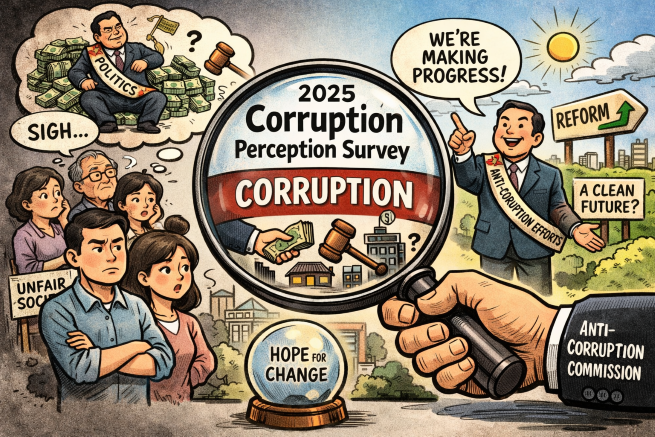
Majority of South Koreans Say Society Is Corrupt and Unfair, Survey Finds (Image supported by ChatGPT)
SEOUL, Jan. 14 (Korea Bizwire) — Nearly four in 10 South Koreans believe corruption is pervasive in the public sector, while a majority view Korean society as broadly corrupt and unfair, according to a nationwide survey released Tuesday, underscoring a persistent gap between government reform efforts and public perception.
The findings come from the 2025 Corruption Perception Survey conducted by the Anti-Corruption and Civil Rights Commission, which polled 1,400 adults alongside business leaders, experts, public officials and foreign residents. About 39 percent of the general public said the civil service is corrupt, up 3.6 percentage points from a year earlier.
By contrast, perceptions of corruption declined among other groups: 31 percent of experts, 23 percent of business leaders, 9 percent of foreigners and just 1 percent of public officials shared that view, all down from the previous year.
Across 11 administrative sectors, respondents most frequently cited the legal and prosecutorial system as the most corrupt, while experts singled out construction, housing and land development. Fire services were consistently rated as the cleanest sector across all groups.
More broadly, 58 percent of the public said Korean society as a whole is corrupt, a slight increase from last year, even as perceptions improved among experts, business leaders, foreigners and civil servants. Half of the public also described society as unfair, though that figure — along with similar responses from other groups — showed improvement from a year earlier.
Political institutions and the legislature were widely viewed as the most corrupt by citizens, experts and public officials, while business leaders pointed to the media and foreigners to religious organizations.
Despite lingering skepticism, assessments of the government’s anti-corruption efforts improved across all groups, with more respondents saying such policies were effective. Optimism about the future also rose sharply, with significantly more people predicting that corruption levels will decline.
Lee Myung-soon, vice chair of the commission, said the results suggest that sustained anti-corruption initiatives are beginning to influence public attitudes, though she acknowledged that skepticism among the general public remains high. “We take this seriously,” she said, pledging to strengthen efforts so citizens can more clearly feel the impact of reforms in daily life.
The survey was conducted in two rounds last year using phone interviews, online questionnaires and in-person surveys, with a confidence level of 95 percent.
M. H. Lee (mhlee@koreabizwire.com)