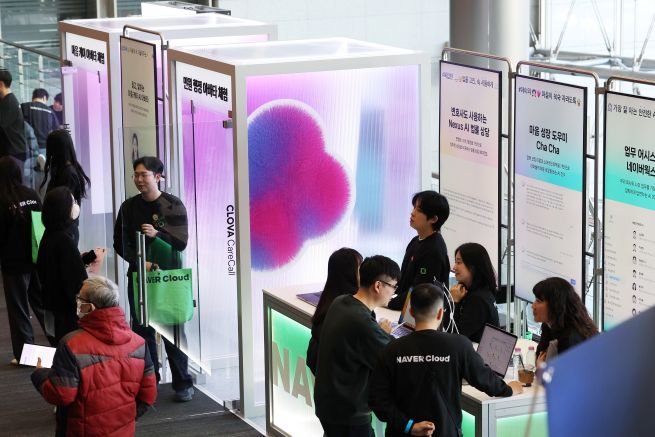
Attention is turning to Naver’s next moves in artificial intelligence after the company failed to advance past the first evaluation round of the government’s independent AI foundation model project. The photo shows attendees visiting the Naver Cloud booth at the project’s first-stage briefing held on Dec. 30 at COEX in Seoul’s Gangnam district. (Yonhap)
SEOUL, Jan. 16 (Korea Bizwire) — South Korea’s effort to crown a homegrown national artificial intelligence model was thrown into turmoil this week after the government abruptly revised the rules of its flagship AI competition, a move that has unsettled the country’s technology sector and raised questions about fairness and transparency.
The Ministry of Science and ICT announced Thursday that it had selected just three teams—LG AI Research, Upstage and SK Telecom—to advance in the first round of its “Independent AI Foundation Model” project, reversing an earlier plan to keep four of the five finalists. The decision meant that two teams, including Naver Cloud and NC AI, were eliminated instead of one.
More controversially, the government simultaneously unveiled a “second-chance” mechanism that would allow eliminated teams—and even companies previously cut before the final round—to reenter the competition.
Officials said an additional team would be chosen through a new evaluation process, with the same access to computing resources, data support and official branding as the original winners.
Ryu Je-myoung, vice minister for science and ICT, said the reset was intended to ensure that all participating firms had an opportunity to reach global competitiveness. Results from the first evaluation, he emphasized, would have “no influence whatsoever” on the next round.
But the sudden rule change has drawn sharp criticism from within the AI industry. Several executives questioned why the competition’s structure was altered only after major players—most notably Naver, long considered one of the country’s top AI contenders—failed to advance. Skeptics have suggested the new framework amounts to a de facto safety net for politically or economically important firms.
Industry observers likened the episode to a notorious controversy in a televised singing competition more than a decade ago, when rules were rewritten midstream to allow a popular contestant to return—an analogy that underscores the reputational risk now facing the government-led project.
The ministry acknowledged that it had not surveyed whether eliminated companies were even willing to participate in the revived contest. Naver Cloud said it was not currently considering reentering, while NC AI said it had yet to decide.
Despite the backlash, officials said they would move quickly to open applications for the next phase, arguing that the broader objective—building a globally competitive Korean AI ecosystem—outweighed concerns over procedural consistency.
For many in the industry, however, the episode has exposed deeper anxieties about governance in state-led technology initiatives, where shifting standards and opaque decision-making can undermine confidence at a critical moment in the global AI race.
Kevin Lee (kevinlee@koreabizwire.com)