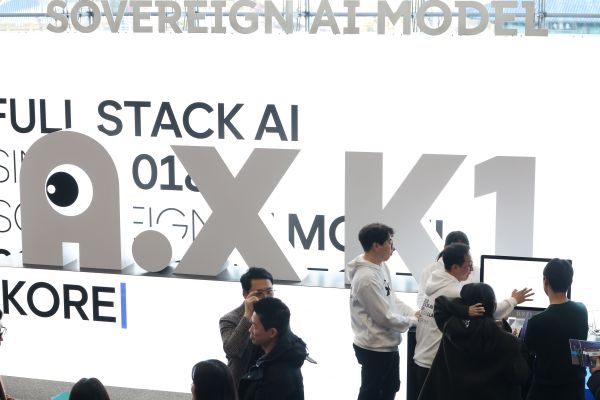
At the first presentation of the “Independent AI Foundation Model” project held on Dec. 30 at COEX in Seoul’s Gangnam District, attendees are seen visiting the booth of SK Telecom (Yonhap)
SEOUL, Jan. 19 (Korea Bizwire) — South Korea’s ambition to build a sovereign artificial intelligence ecosystem was jolted this week after the government’s first evaluation of its national A.I. foundation model program eliminated two of the country’s most prominent technology players, exposing deep uncertainties about what “independent A.I.” truly means — and whether Korea can realistically compete with global powers.
The Ministry of Science and ICT announced that only three companies — LG AI Research, SK Telecom and the startup Upstage — advanced as candidates for a state-backed “national A.I.” model. Naver Cloud, long regarded as the standard-bearer of Korean A.I., and NCSoft, the gaming giant, were both disqualified.
Officials said Naver’s model failed to meet independence requirements because it relied on the encoder and core weights of Qwen, an open-weight model developed by China’s Alibaba.
Under government rules, foundation models must be built “from scratch,” beginning with zeroed weights and independently trained across the entire pretraining process.
The decision has sent shock waves through the country’s technology sector, raising questions about the credibility of Korea’s long-promoted goal of becoming one of the world’s three leading A.I. powers.
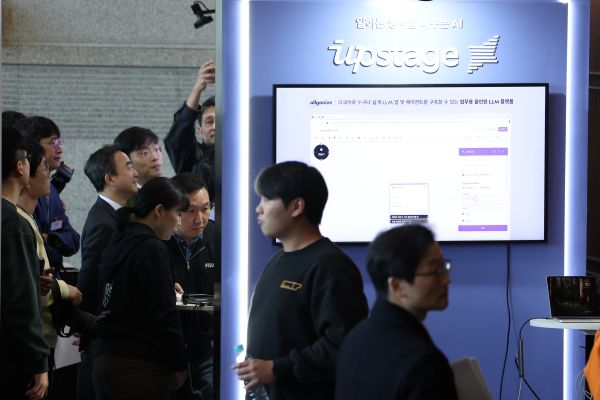
At the first presentation of the “Independent AI Foundation Model” project held on Dec. 30 at COEX in Seoul’s Gangnam District, attendees are seen visiting the booth of startup Upstage. (Yonhap)
At the heart of the controversy lies a technical distinction with sweeping implications: the difference between pretraining and fine-tuning.
While many Korean-language A.I. services rely on adapting foreign open models through fine-tuning, the government has drawn a firm line, ruling that models borrowing core weights — no matter how localized their performance — cannot be considered sovereign.
In effect, officials said, a finely tuned Chinese or American engine remains foreign at its core.
The episode has highlighted Korea’s increasingly precarious position in the global A.I. race.
The United States dominates the field through companies like OpenAI, Google and Meta, controlling not only models but also cloud infrastructure and advanced chips.
China, despite U.S. export controls, has pushed aggressively toward self-reliance, with firms such as Alibaba and Tencent developing proprietary architectures.
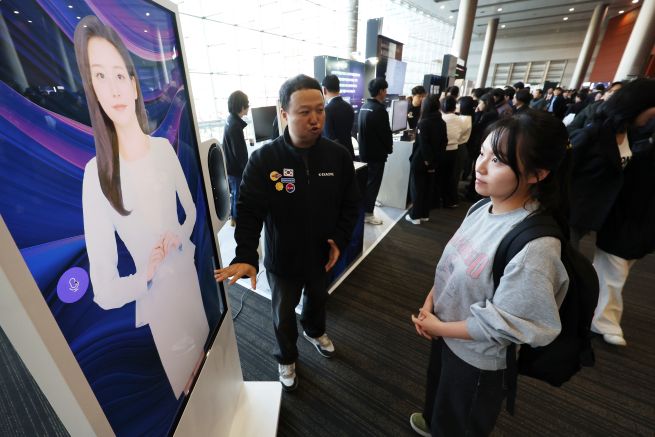
The LG AI Research booth at the first presentation of the “Sovereign AI Foundation Model” project, held on Dec. 30 at COEX in Gangnam, Seoul. (Yonhap)
Even countries with far smaller markets, including France and the United Arab Emirates, have mobilized national strategies around so-called sovereign A.I. models.
Against that backdrop, Korea’s reliance on Chinese open-weight models — now laid bare — has triggered anxiety that the country risks falling behind both superpowers and emerging challengers.
Government officials argue that independence is not a matter of pride but of national security and industrial survival. Foreign A.I. systems raise concerns over data sovereignty, cybersecurity and legal accountability, particularly when handling sensitive government or corporate information.
Domestic models, they say, are also essential for accurately understanding Korea’s legal system, language nuances and social context — areas where foreign systems often falter.
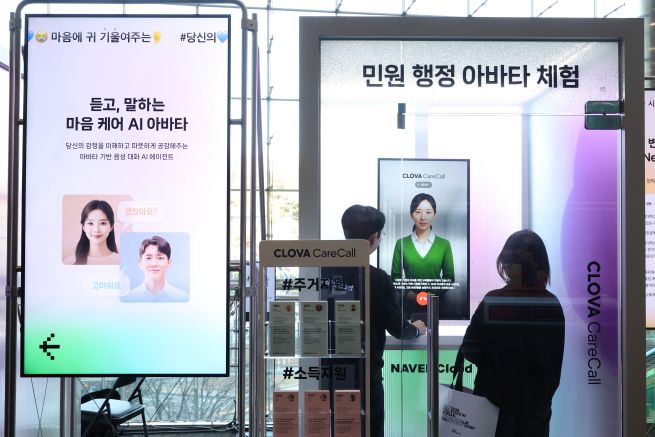
Naver’s cloud booth at the first presentation of the “Sovereign AI Foundation Model” project, held on Dec. 30 at COEX in Gangnam, Seoul. (Yonhap)
Equally important is the industrial value chain. Without domestic foundation models, Korea’s ambitions to link homegrown A.I. semiconductors, data centers and services could collapse, leaving local firms dependent on foreign platforms for high-value innovation.
Still, critics warn that pursuing massive general-purpose models may be unrealistic given Korea’s limited data and capital compared with U.S. and Chinese giants.
Instead, many experts now argue for a strategic pivot toward smaller, specialized sovereign models tailored to Korean-language domains such as law, healthcare, defense and public administration.
The government is expected to refine its policy framework, clarifying transparency rules around open-source use and potentially adopting a dual-track approach — supporting both core technology developers and application-focused firms.
For now, the rejection of Naver and NCSoft has become a defining moment for Korea’s A.I. ambitions.
Whether it marks the beginning of a more disciplined push toward genuine technological independence — or a sign of how far the country still must go — remains an open question.
Kevin Lee (kevinlee@koreabizwire.com)