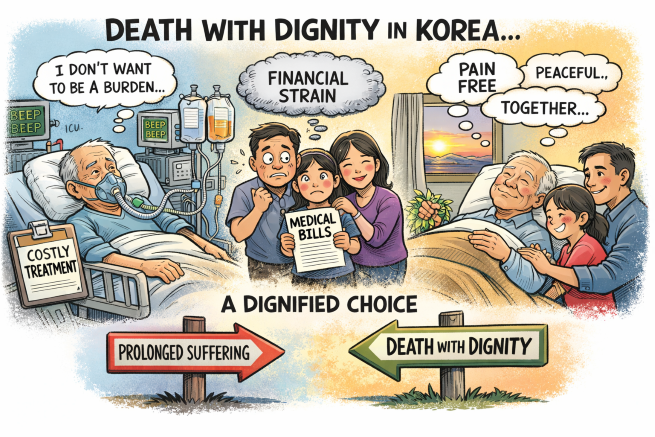
South Koreans Say a Death With Dignity Means Less Pain and Fewer Burdens on Family (Image supported by ChatGPT)
SEOUL, Jan. 20 (Korea Bizwire) — For many South Koreans, a dignified end of life means minimizing physical suffering and sparing loved ones from financial strain, according to a new nationwide study that sheds light on changing attitudes toward death in one of the world’s fastest-aging societies.
The research, released Monday by the Korea Institute for Health and Social Affairs, found that while most adults have reflected on their own death or end-of-life care, fewer than half have discussed those wishes with their families.
The study, published in the institute’s academic journal Health and Social Welfare Review, analyzed responses from 1,021 adults aged 19 and older who participated in an online survey conducted in April and May 2024.
Nearly 79 percent of respondents said they think about their own death or end-of-life situation at least occasionally, with women and married individuals more likely to do so than men or unmarried respondents. Yet only 45.7 percent said they had ever spoken with family members — including parents, spouses or children — about such matters.
When asked what constitutes a death with dignity, respondents overwhelmingly pointed to relief from suffering. Ninety-seven percent said minimizing physical pain was important, followed closely by avoiding financial hardship for family members and reducing the burden of long-term caregiving.

As Korea Ages, Views on Death With Dignity Are Quietly Shifting (Yonhap)
Notably, concerns about burden outweighed emotional preferences. Fewer respondents ranked being surrounded by family and friends at the moment of death as a top priority, suggesting that practical considerations now play a central role in how Koreans envision the end of life.
The survey also found strong support for hospice and palliative care. More than 81 percent said they would be willing to use such services if they were diagnosed with a terminal illness, though concerns over cost and the perception that hospice facilities are “places where one waits for death” remained major barriers.
Attitudes toward life-sustaining treatment were even more decisive. Nearly 92 percent of respondents said they would choose to forgo life-prolonging medical interventions if recovery were no longer possible, citing a desire not to impose emotional or financial strain on their families.
Those who opposed withdrawing treatment most often cited fear of death or concerns about unmanaged pain.
The findings come as participation in South Korea’s advance medical directive system continues to climb. As of the end of 2025, more than 3.2 million people had registered documents stating their wish to decline life-sustaining treatment at the end of life — nearly a quarter of the country’s population aged 65 and older.
The number has risen steadily since the Life-Sustaining Treatment Decision Act, often referred to as the “death with dignity law,” took effect in 2018.
Researchers said the results reflect a growing public consensus around autonomy at the end of life, alongside persistent gaps in understanding and access.
“Concerns about pain and the desire not to burden family members are central to how people define a death with dignity,” the study’s authors wrote. “Clearer information about pain control, hospice costs and decision-making procedures is essential to help individuals make informed choices.”
As South Korea confronts rapid aging and rising end-of-life care needs, the study suggests that conversations about dying — once avoided — are becoming an increasingly urgent part of public life.
Lina Jang (linajang@koreabizwire.com)